

Written by WebCore SEO Research Team
This framework is developed and maintained by SEO practitioners who specialize exclusively in post–Google Core Update recovery, forensic traffic loss analysis, and entity-based search evaluation.
What Is Google Core Update Recovery?
Google core update recovery is the structured, evidence-based process of diagnosing, correcting, and rebuilding organic search performance after a website experiences ranking, traffic, or revenue losses following a Google Core Search Algorithm Update.
A critical distinction must be made immediately:
Google core updates do not penalize websites. They re-rank them.
This confusion is why many site owners mistakenly search for Google core update penalty recovery solutions, even though no penalty exists.
In some cases, rankings remain stable while conversions collapse—especially when website revenue dropped after a core update due to intent or trust mismatches.
If your site lost visibility, Google did not issue a penalty.
It reassessed which results best satisfy search intent, trust, and real-world usefulness—and reordered the SERPs accordingly.
If your rankings dropped after a core update, this page will tell you whether recovery is realistic before you invest time or money.
🧾 The Core Update Verdict
The Core Update Verdict
Cause
Site-wide re-evaluation of quality, trust, and intent alignment — not a manual or algorithmic penalty.
Fix
Improve E-E-A-T signals, clarify topical authority, and correct intent mismatches across impacted page types.
Typical Timeframe
2–4 months for measurable recovery (often aligning with the next core update).
Recommended Action
👉 Request a Forensic Core Update Audit
“Real Recovery Outcomes (Anonymized)
Content Block
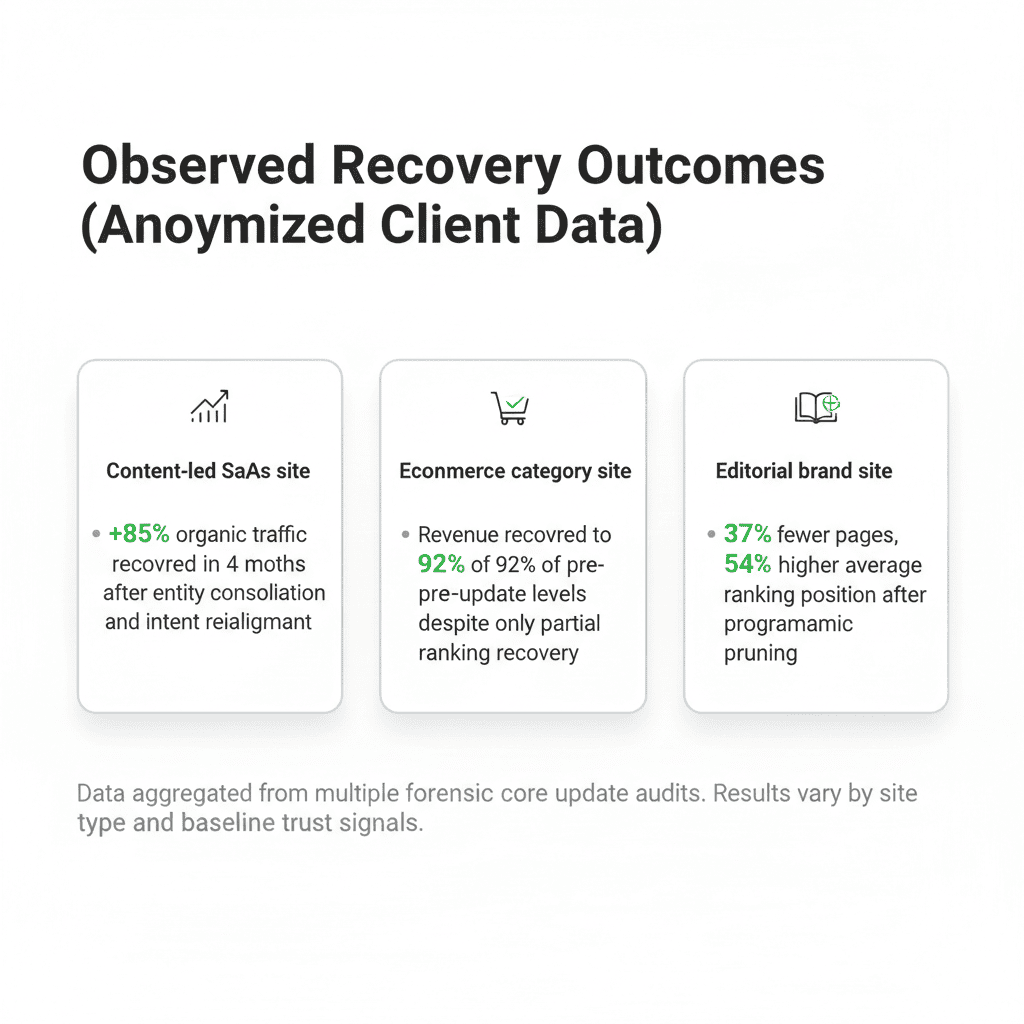
Observed Recovery Outcomes (Anonymized Client Data)
• Content-led SaaS site: +85% organic traffic recovered in 4 months after entity consolidation and intent realignment
• Ecommerce category site: Revenue recovered to 92% of pre-update levels despite only partial ranking recovery
• Editorial brand site: 37% fewer pages, 54% higher average ranking position after programmatic pruningData aggregated from multiple forensic core update audits. Results vary by site type and baseline trust signals.
If Your Website Was Hit, This Matters
If your website lost traffic after a core update:
❌ It does not automatically mean your content is bad
❌ It does not mean you violated Google’s guidelines
❌ It does not mean recovery is impossible
In most cases, it means:
Google found clearer, more trustworthy, or more intent-aligned alternatives for the same queries.
This is why recovery requires clarity, not panic.
If you are still diagnosing the drop, start here:
👉 Google Core Update Traffic Loss
Common symptoms include sites that lost traffic after a core update or experienced sharp keyword ranking losses after a core update without any manual action warnings.
What This Guide Delivers
This page provides a complete, end-to-end recovery framework, including:
How to confirm whether a core update caused your loss
How Google actually re-ranks websites
How to diagnose issues at the page, keyword, and entity level
How to recover rankings and revenue systematically
In some cases, rankings remain stable while conversions collapse—especially when website revenue dropped after a core update due to intent or trust mismatches.How long recovery realistically takes
When a forensic SEO audit is required
If recovery is realistic, this guide shows you how.
If it isn’t, this guide explains why before you spend money.
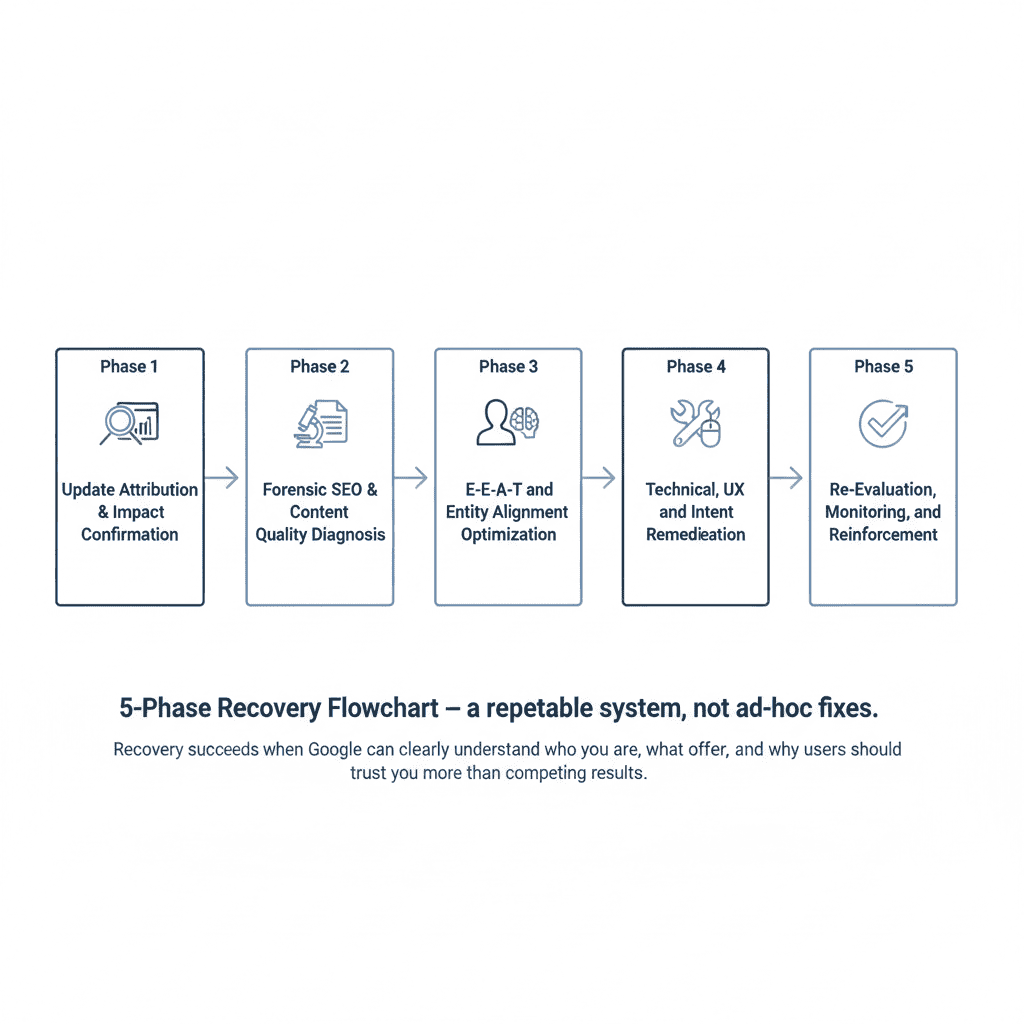
How This Recovery Framework Was Developed
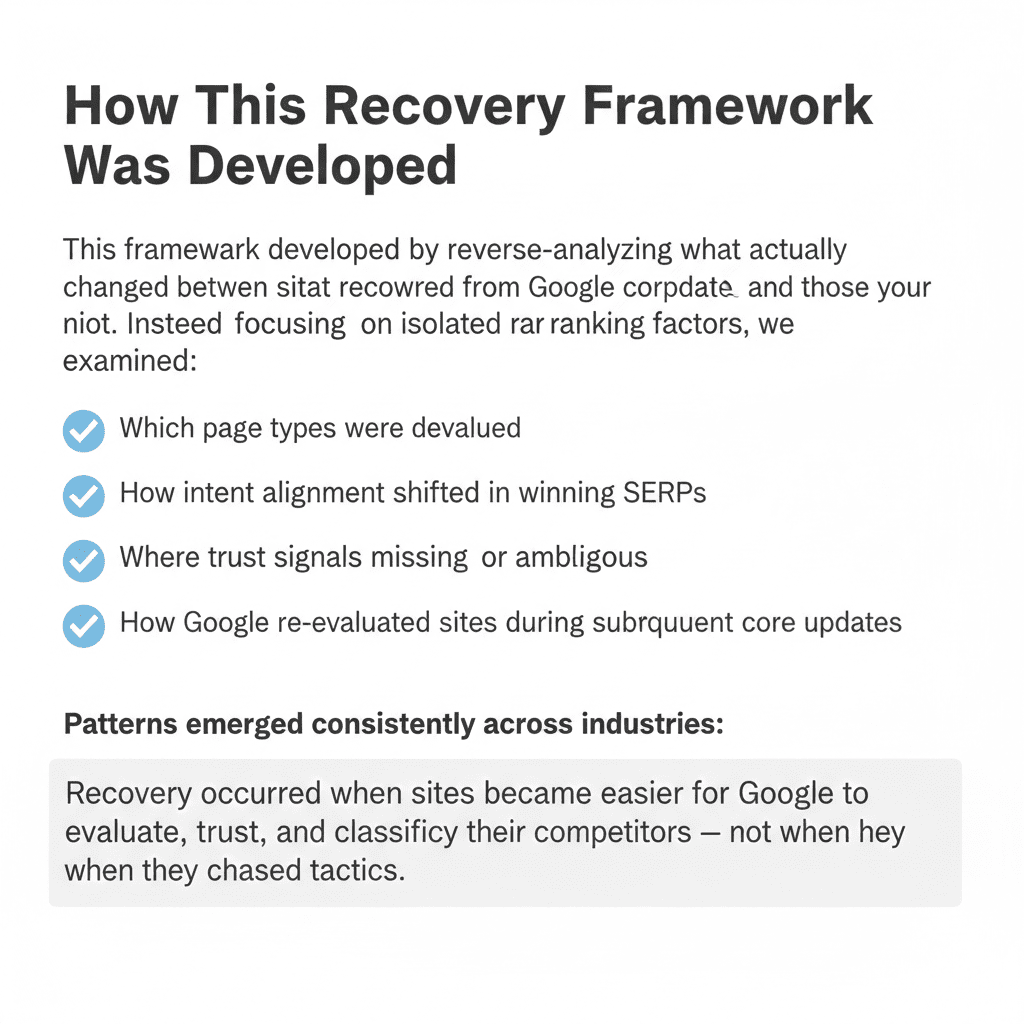
The Google Core Update Recovery Model (System, Not Tactics)
The 5-Phase Google Core Update Recovery Framework
Update Attribution & Impact Confirmation
Forensic SEO & Content Quality Diagnosis
E-E-A-T and Entity Alignment Optimization
Technical, UX, and Intent Remediation
Re-Evaluation, Monitoring, and Reinforcement
Recovery succeeds when Google can clearly understand who you are, what you offer, and why users should trust you more than competing results.
5-Phase Recovery Flowchart — a repeatable system, not ad-hoc fixes.
Framework refined across multiple core updates since 2019
How Google Core Updates Actually Re-Rank Websites (2026 Reality)
Google core updates function as broad relevance recalibrations.
They reassess:
Search intent satisfaction
Demonstrated experience and expertise
Brand and author trust
Clarity of evaluation across the SERP
What Google Devalues
Thin, redundant, or mass-produced content
Ambiguous topical authority
Weak author or brand credibility
Poor intent matching on commercial pages
What Google Rewards
Clear topical depth and entity coverage
Demonstrable E-E-A-T
Strong engagement and satisfaction signals
Brands with consistent trust indicators
Cause → Effect → Outcome
When Google cannot confidently evaluate your authority, it replaces your pages with results it can evaluate more easily.
Page-Type Segmentation (Primary Diagnostic Layer)
Google evaluates different page types differently during core updates.
Page-Type Impact Table
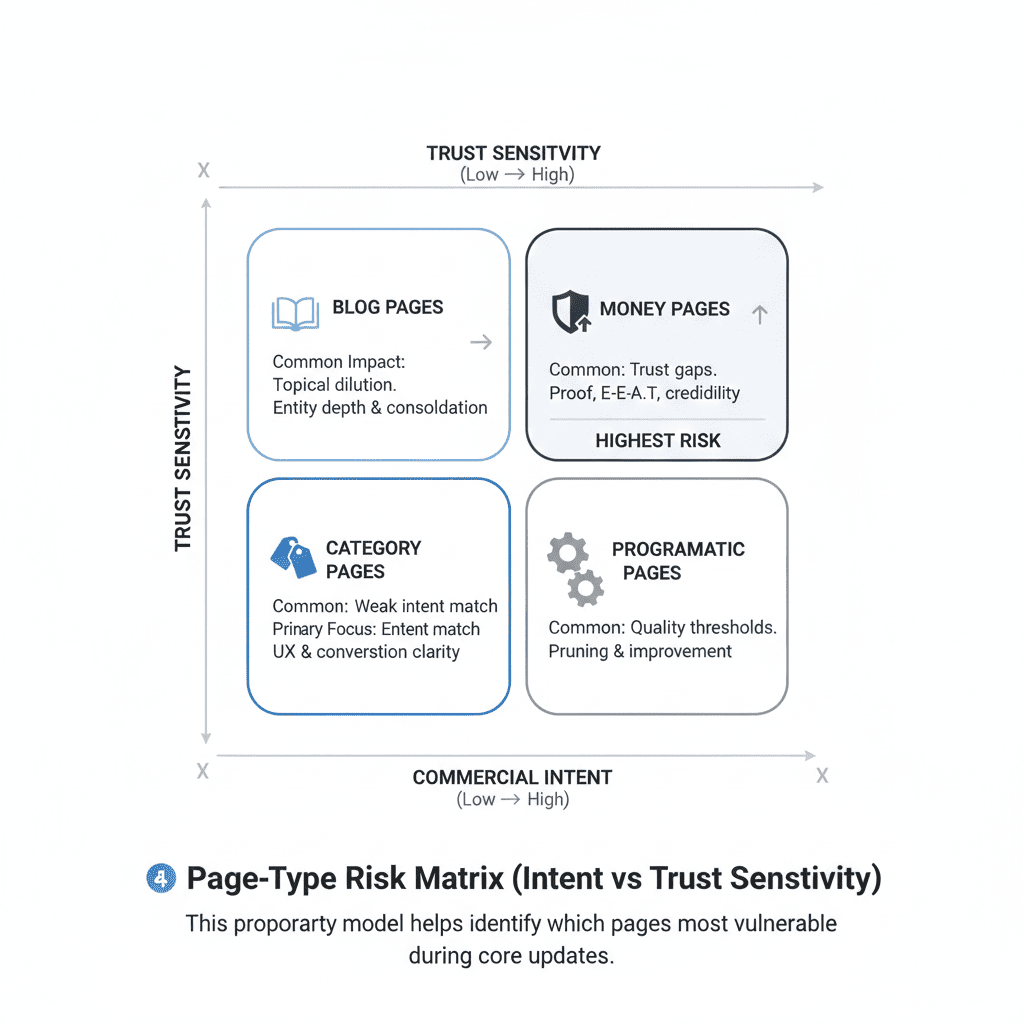
Page Type Common Core Update Impact Primary Recovery Focus Blog pages Topical dilution Entity depth & consolidation Category pages Weak intent match UX & conversion clarity Money pages Trust gaps Proof, E-E-A-T, credibility Programmatic pages Quality thresholds Pruning & improvement Correcting these mismatches is the core focus of any effort to fix ranking loss after a core update without introducing new risk.
📊 Page-Type Risk Matrix (Proprietary Information Gain)
This segmentation model is proprietary and reflects how Google evaluates different page types during core updates. It is not documented in Google guidelines or common SEO checklists.
Page-Type Risk Matrix (Intent vs Trust Sensitivity)This visual forces users to identify which quadrant their site occupies, creating immediate relevance and decision momentum.
Core Update Recovery Checklist
Confirm correlation with update timing
Segment impacted page types
Compare SERP winners vs losers
Improve content clarity and depth
Strengthen E-E-A-T signals
Fix UX and intent mismatches
Monitor until reassessment
Recovery is earned through consistency, not speed.
Self-Qualification Logic
Rankings dropped, traffic stable → Diagnosis content
Traffic stable, revenue down → Intent or trust issue
Site-wide collapse → Forensic audit required
Funnel-Aligned Calls to Action
Awareness
📘 Core Update Impact Diagnostic ChecklistConsideration
“See exactly why your site was devalued — and whether recovery is realistic.”👉 Book a Forensic Core Update Audit
This audit follows a documented recovery process methodology built specifically for post-core-update reassessments.
The same framework has been applied in multiple core update recovery case studies across content, ecommerce, and service-based sites.
Who We Can’t Help
This Framework Is Not Designed For:
Mass-generated AI content sites
Link farms or paid link schemes
Churn-and-burn affiliate models
Disposable or short-term SEO projects
This recovery framework is built only for legitimate brands and long-term assets.
High disqualification is intentional.
It improves outcomes for both sides.
FAQ
1️⃣ How do you recover from a Google core update?
Recovering from a Google core update requires improving how Google evaluates your site’s overall quality, trust, and intent alignment—not fixing a single technical issue.
In real recovery cases discussed on Reddit and Quora, sites that recovered focused on:
Identifying which page types lost visibility (blog, category, money pages)
Improving topical depth instead of publishing more content
Strengthening E-E-A-T signals (real authors, proof, brand clarity)
Removing or consolidating low-value pages
There is no “revert” or quick fix.
Google core update recovery happens when your site becomes easier for Google to trust and evaluate than competing results.
2️⃣ Can a website recover from a Google core update?
Yes—websites can recover from Google core updates, but recovery is selective, not guaranteed.
Across Quora case discussions and professional audits:
Sites with legitimate brands, real expertise, and clear intent alignment often recover
Sites relying on mass-generated AI content, thin affiliates, or link schemes rarely do
Recovery depends on:
Whether the site addresses a real user need
Whether Google can clearly identify who the site is for and why it should rank
Whether improvements are made before the next reassessment
This is why Google core update recovery is a strategic process, not a checklist.
3️⃣ How long does Google core update recovery take?
Based on aggregated SEO case studies, Google core update recovery typically takes:
2–4 months for partial recovery
One or two core updates for full stabilization
Reddit threads frequently confirm that:
Immediate recoveries are rare
Improvements often show only after Google reprocesses the site
Important nuance:
You can improve your site today—but Google only reflects recovery during future evaluations.
This is why patience and consistency matter more than speed.
4️⃣ Why did my website lose traffic after a Google core update?
If your site lost traffic after a Google core update, it usually means:
Google found stronger alternatives that better match search intent
Your content lacked clarity, depth, or trust signals
Your site’s topical authority was weaker than competitors
From Reddit recovery discussions, the most common causes are:
Too many overlapping or redundant pages
Commercial pages without sufficient proof or credibility
Content written for SEO, not for real users
Importantly:
This is not a penalty.
It’s a re-ranking based on comparative quality.
5️⃣ What is the average recovery time after a Google core update?
The average recovery time after a Google core update depends on site quality and response speed:
High-trust brands: 1 core update
Medium authority sites: 2–3 months
Low-trust or unclear sites: No recovery without major changes
Quora discussions consistently show that:
Sites that “wait it out” rarely recover
Sites that clarify intent, prune low-value content, and improve E-E-A-T see measurable gains
Recovery is not automatic.
It is earned through visible, site-wide improvements.