

If your website revenue dropped after core update, you are not alone. Many site owners experience sudden organic decline even when pages remain indexed and rankings appear unchanged. This creates confusion, misdiagnosis, and wasted remediation effort — especially when teams apply generic fixes instead of structured SEO recovery methodology.
Google core update traffic loss refers to a decline in organic sessions following a broad algorithm reassessment — often without penalties and without deindexation. In most cases, the issue is not technical failure but comparative usefulness recalibration and SERP visibility redistribution — which is why modern Google core update recovery frameworks focus on diagnosis, alignment, and entity trust rebuilding rather than quick fixes.
Common reported patterns include:
traffic loss after google core update
google core update traffic drop
website lost traffic after core update
google update traffic loss
traffic drop with same rankings
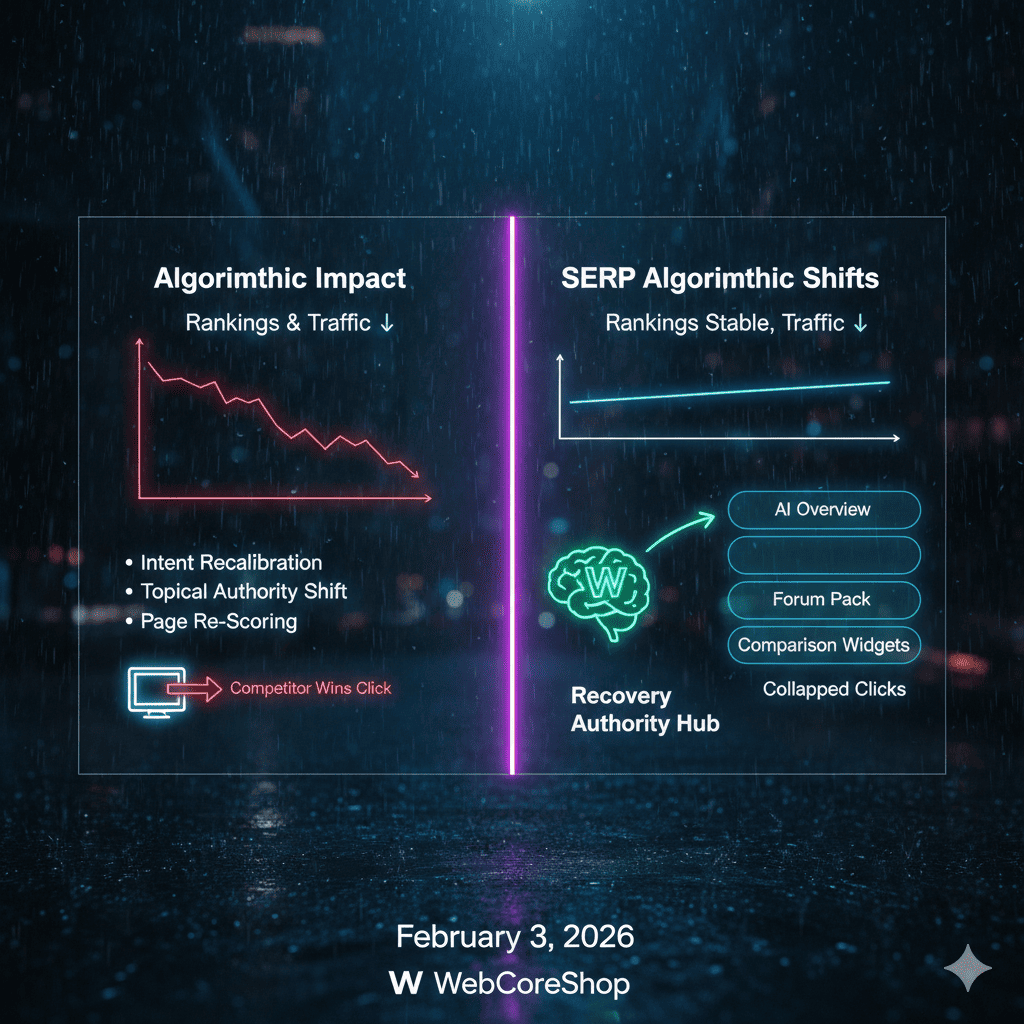
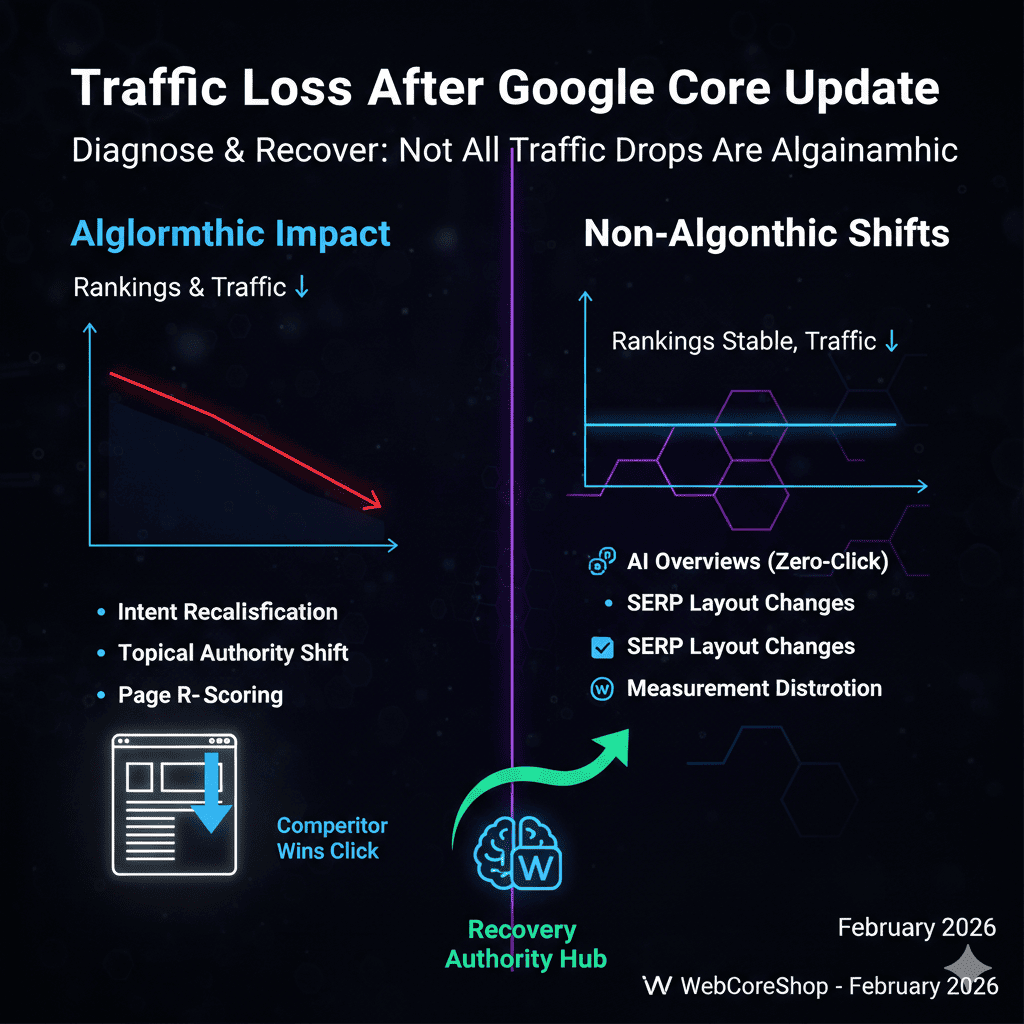
This guide is built as a diagnostic and recovery authority hub — designed to separate real algorithmic impact from SERP layout shifts, intent reclassification, and measurement distortion.
For a deeper breakdown of why sites lose traffic even without penalties, see:
👉 Google core update traffic loss — why your site lost traffic
Lost traffic after Google core update
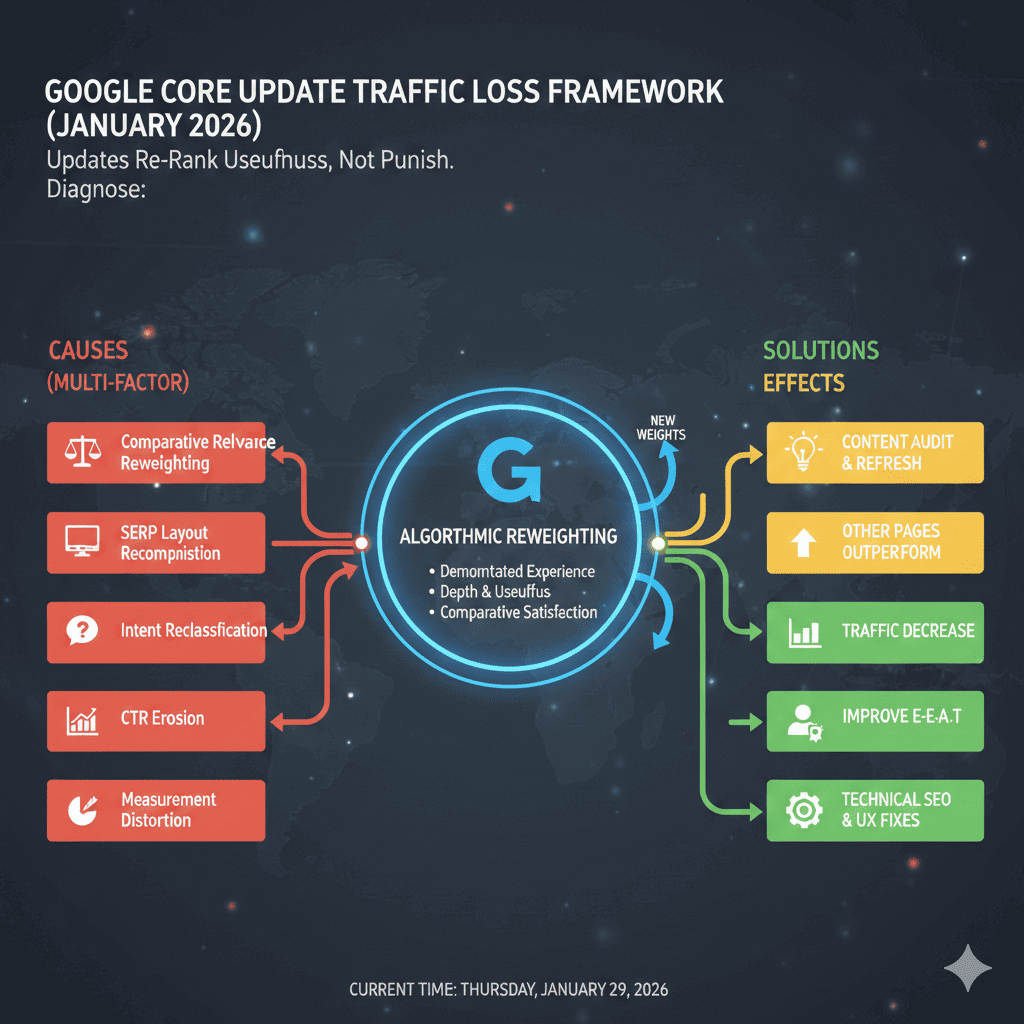
Google core updates do not punish websites. They re-rank usefulness comparatively across the index. When traffic drops, the cause is usually one or more of the following:
Comparative relevance reweighting
SERP layout recomposition
Intent reclassification
CTR erosion
Measurement distortion
The Core Update Traffic Loss Framework
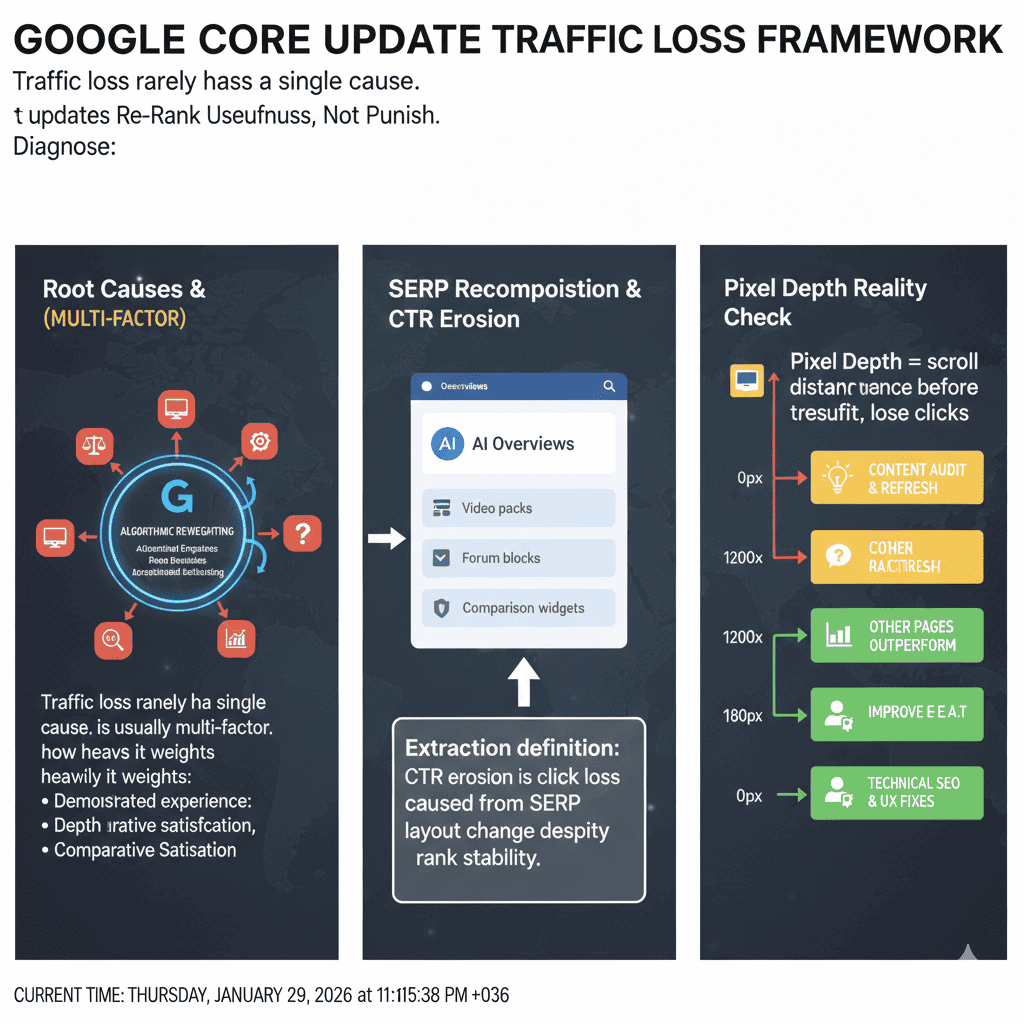
Traffic loss rarely has a single cause. It is usually multi-factor.
Algorithmic Reweighting
Google changes how heavily it weights:
Demonstrated experience
Depth and usefulness
Comparative satisfaction
Other pages outperform under new weights.
This type of loss typically correlates with lost keyword rankings after a core update, even when content quality appears unchanged. For page-level recovery scenarios, see:
👉 Lost keyword rankings after core update — recover fast in 2026
SERP Recomposition and CTR Erosion
SERPs now include:
AI Overviews
Video packs
Forum blocks
Comparison widgets
Even stable rankings can lose clicks.
Extraction definition: CTR erosion is click loss caused by SERP layout change despite rank stability.
If your rankings look stable but clicks collapsed, this is diagnosable. Message our SEO team for a free SERP visibility audit → we’ll measure your pixel depth and click exposure.
Pixel Depth Reality Check
Pixel Depth = scroll distance before first organic result.
If your listing moved from 600px to 1800px depth, traffic loss is expected.
For a tactical diagnostic and recovery workflow, see:
👉 Website lost traffic after core update — diagnose & recover rankings fast
Competitive SERP Delta Table
| Element | Before | After | Impact |
|---|---|---|---|
| AI Overview | No | Yes | High |
| Video Block | Low | Top | High |
| Forums | Hidden | Prominent | Medium |
What Ranking Winners Did Differently
Post-update winners typically show:
Experience-backed content
Scenario coverage
Entity clarity
Author trust signals
Comparison depth
They did not “SEO harder.” They aligned better.
Case Mini-Story
A publisher lost 38% traffic with unchanged rankings.
Root cause:
Pixel depth doubled
AI Overview inserted
Content lacked experiential proof
Fix:
Added real examples
Added scenario coverage
Improved snippet clarity
Cases like this are common after core updates. If you want to know whether your drop follows a similar pattern, start a free WhatsApp SEO consultation → We’ll tell you within 48 hours what caused it.
Structured Recovery Scenarios
Scenario A — Rank stable, traffic down → SERP CTR erosion
Scenario B — Rank down, impressions down → comparative reweighting
Scenario C — Sessions down only → tracking distortion
In short:
Most traffic loss after core updates comes from SERP visibility redistribution and intent mismatch, not penalties.
Google core update recovery
Recovery is not a patch. It is a recalibration process.
Fix ranking loss after google update
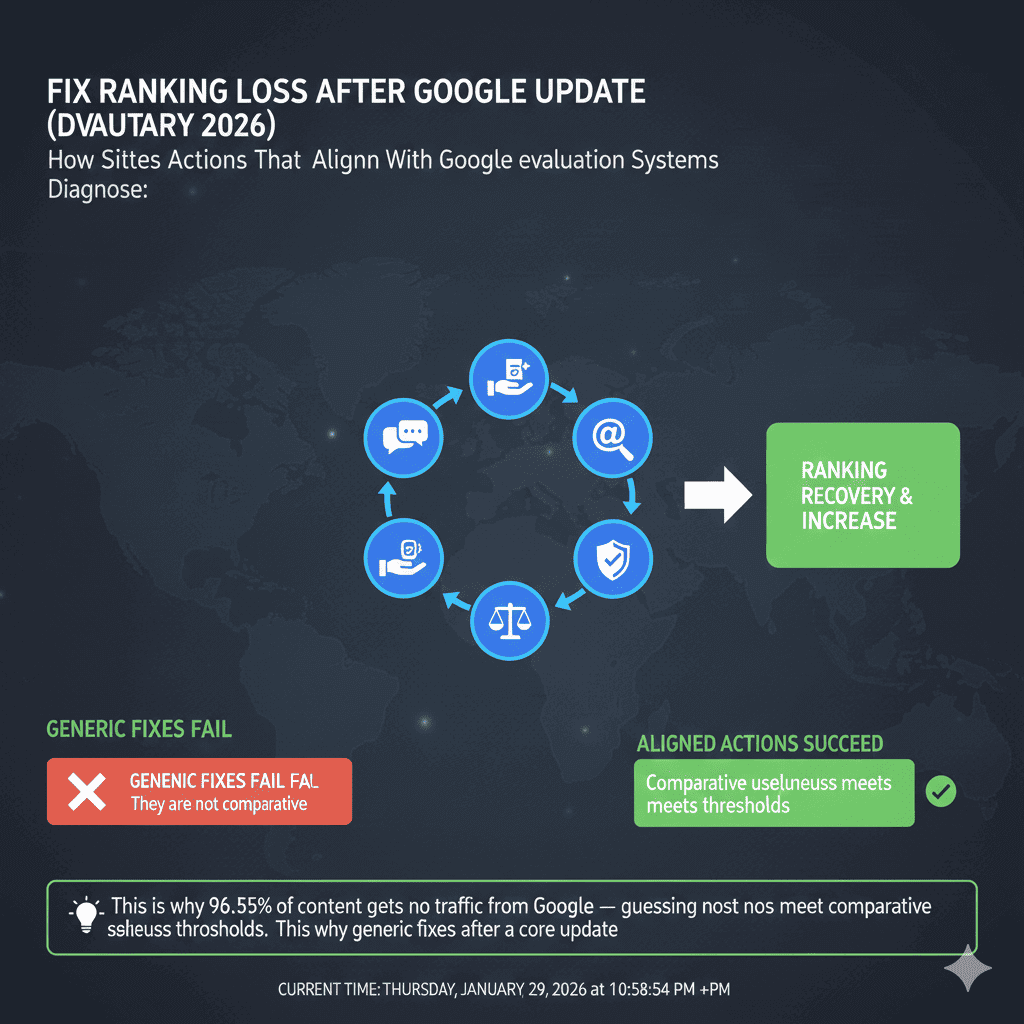
Recovery actions that align with Google evaluation systems:
Intent completeness
Experience signals
Entity clarity
Comparative usefulness
Trust reinforcement
Generic fixes fail because they are not comparative.
“This is why 96.55% of content gets no traffic from Google — guessing does not meet comparative usefulness thresholds. This is why generic fixes fail after a core update.”
Lost keyword rankings after core update
Keyword loss often reflects:
Intent shift
Better competitor alignment
SERP feature displacement
This requires page-level comparative analysis.
How to survive Google updates
Sites that survive updates consistently:
Publish experience-backed content
Cover scenarios, not just definitions
Show author and brand trust
Maintain topical coherence
How can I prepare for a core update
Preparation principles:
Build entity authority
Strengthen E-E-A-T signals
Maintain intent coverage
Run forensic audits regularly
When discussing audit tooling, users often ask is Ahrefs a good SEO tool — yes for competitive and link analysis, but core update recovery requires multi-signal audits, not one tool.
Recovery Timeline Scenarios
SERP layout loss → 2–6 weeks improvement window
Quality threshold loss → next refresh cycle
Entity trust gap → multi-update cycle
Core Update Diagnostic Checklist
☐ Confirm update timing
☐ Compare impressions
☐ Measure pixel depth
☐ Compare winners
☐ Validate tracking
☐ Audit intent match
Not sure how your checklist results translate into action? Get a free expert interpretation via WhatsApp → we’ll confirm whether recovery is realistic before you invest resources.
If You Only Check 3 Metrics After a Core Update
Search Console impressions
Pixel depth
SERP feature changes
LLM and SGE systems strongly favor triage lists like this.
Why is my website not getting any traffic
This is diagnostic intent — not beginner curiosity.
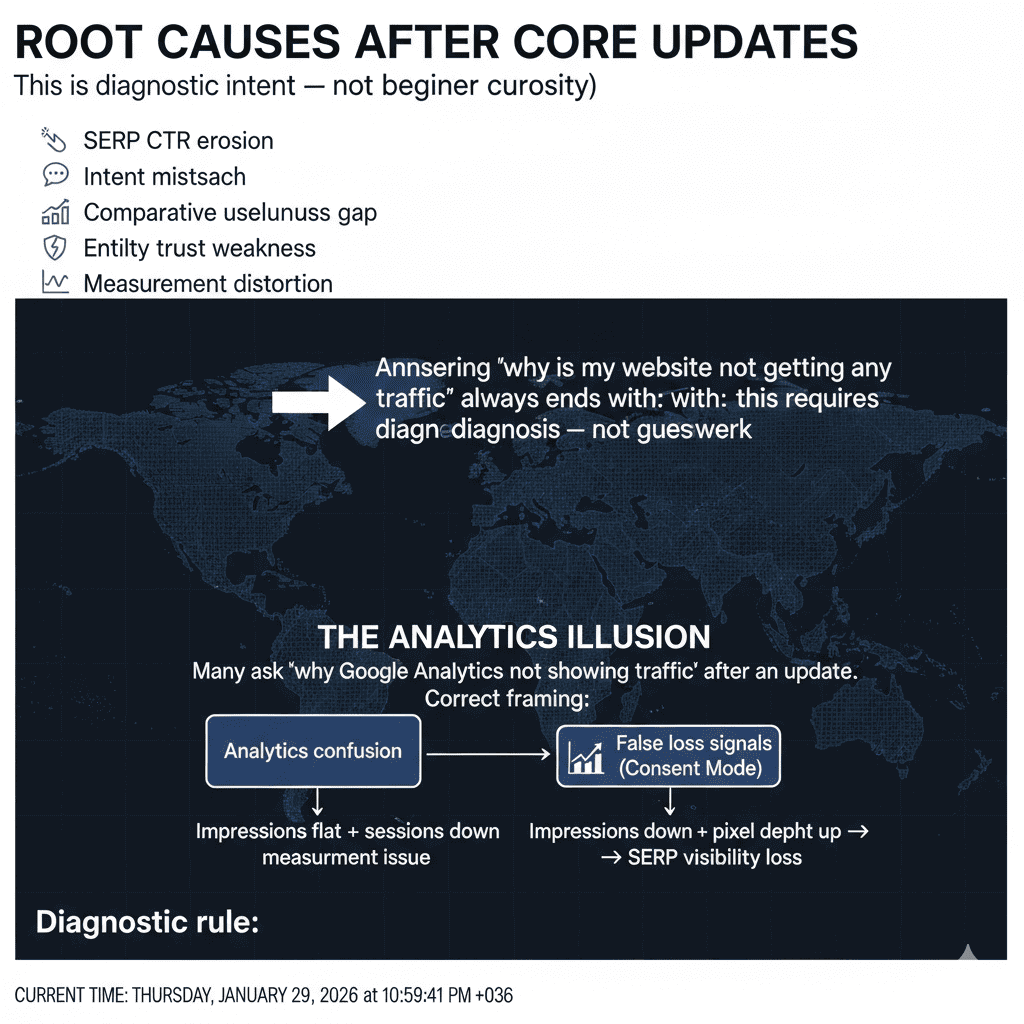
Root Causes After Core Updates
SERP CTR erosion
Intent mismatch
Comparative usefulness gap
Entity trust weakness
Measurement distortion
Answering why is my website not getting any traffic always ends with:
this requires diagnosis — not guesswork.
The Analytics Illusion
Many ask why is Google Analytics not showing traffic after an update.
Correct framing:
Analytics confusion often hides real ranking or visibility loss — or creates false loss signals due to Consent Mode modeling differences. This is measurement vs ranking, not a GA tutorial issue.
Diagnostic rule:
Impressions flat + sessions down → measurement issue
Impressions down + pixel depth up → SERP visibility loss
Decision Tree Diagnostic Block
Did impressions drop?
├─ No → Check pixel depth
└─ Yes → Check rankings
├─ Down → Reweighting
└─ Stable → Intent shift
Entity Relationship Table
| Concept | Related System | Diagnostic Role |
|---|---|---|
| Core Update | Ranking | Reweighting |
| CTR Erosion | SERP | Click loss |
| Pixel Depth | SERP UX | Visibility |
| Consent Mode | GA4 | Measurement |
Scenario Comparison Table
| Symptom | Cause | Fix |
|---|---|---|
| Same rank, less traffic | Pixel depth | Snippet & format |
| Impressions down | Intent shift | Content realignment |
| Sessions only down | Modeling | Tracking fix |
FAQ
Did Google finish rolling out its December 2025 core update
Rollouts complete in phases; impact assessment should continue weeks after.
What is the June 2025 core update
A broad ranking reassessment update affecting comparative usefulness scoring.
What are the effects of Google core update
Ranking reshuffles, CTR redistribution, intent reclassification.
What does Google Core do
It recalibrates ranking weights across quality and relevance signals.
How often are Google core updates
Multiple times per year, with periodic refreshes.
Does SEO still work in 2025
Yes — but entity trust and intent completeness now dominate.
Core update traffic loss is rarely a penalty. It is a visibility and usefulness redistribution event. Diagnosis beats reaction. Structured recovery beats random fixes.
For teams asking how to boost traffic on Google, the correct path is: diagnose → align → reinforce — not guess.