Estimated read time: 6–7 minutes
Originally published: August 15, 2025
Last reviewed and updated: August 14, 2026
Quick Answer: A Local SEO strategy for a service-area business connects its genuine services and coverage areas with an eligible Google Business Profile, clearly owned service and service-area pages, trustworthy local signals and measurable customer actions. The roadmap should prioritize implementation according to commercial importance, available evidence and realistic geographic reach—not the number of cities a business wants to claim.
Can a Service-Area Business Rank Without a Physical Storefront?
This framework is designed for plumbers, electricians, HVAC contractors, cleaners, roofers and other mobile service businesses whose teams travel to customers.
Can a Service-Area Business Rank Without a Physical Storefront?
Yes. An eligible service-area business can appear in Google Search and Maps without displaying a public storefront. It should configure its Google Business Profile to reflect how it genuinely operates, hide the address when customers do not visit it and define accurate service areas.
Need implementation rather than another generic checklist? WebCoreShop can assess your website, Google Business Profile and genuine coverage area before defining a managed Local SEO service scope.
Key Takeaways
- A service area business should target only locations it genuinely serves.
- Google Business Profile service areas do not guarantee visibility in every selected city.
- Your Google Business Profile, service pages and service area pages should represent the same legitimate business model.
- Service area pages need unique local value—not the same copy with different city names.
- The roadmap should prioritize actions by business effect, evidence and available resources.
- Calls, forms, booked jobs and qualified enquiries are more useful commercial KPIs than impressions alone.
- Rankings, traffic, calls, leads, bookings and revenue cannot be guaranteed.
How a Local SEO Strategy Works for Service Area Businesses
A Local SEO strategy for a service-area business coordinates the company’s genuine services, markets, search assets and measurement priorities. It is not the complete managed-service offer; it establishes what should be implemented, in what order and by whom.
A service area business may include a plumber, electrician, HVAC contractor, cleaner, roofer, mobile technician or another professional who serves customers across defined geographic markets.
Its Local SEO strategy needs to connect:
- Genuine services and coverage areas
- An eligible Google Business Profile
- Main service pages
- Selected service area pages
- Consistent business information
- Genuine reviews and local evidence
- Calls, forms and booking measurement
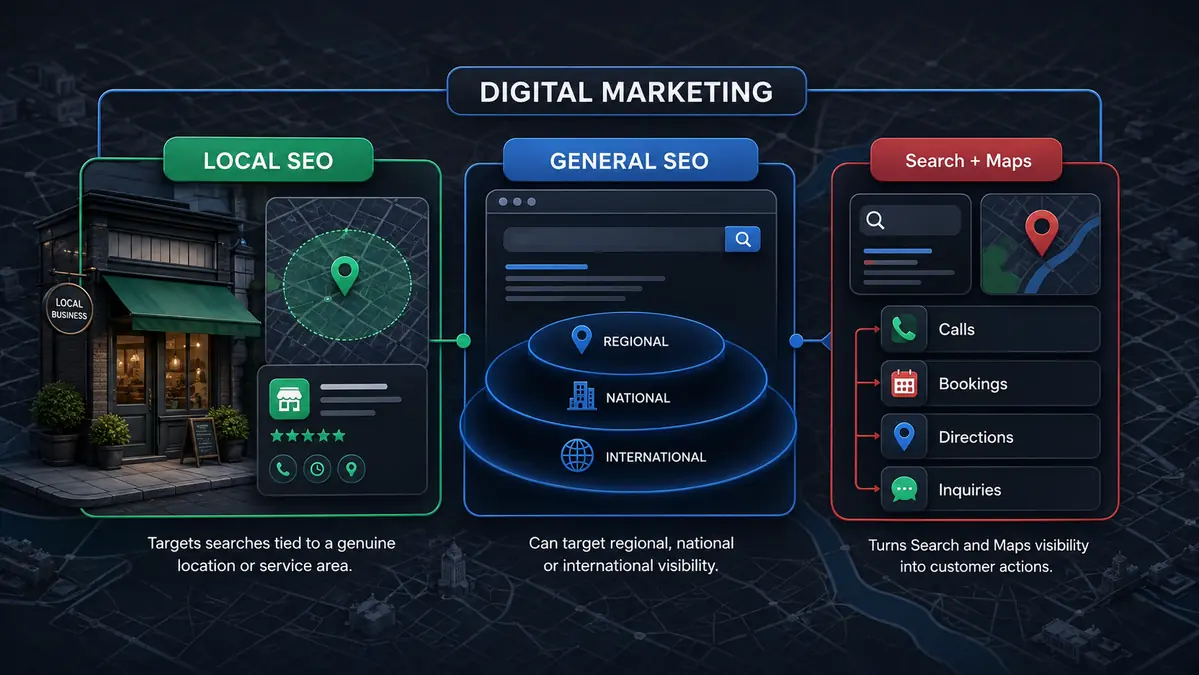
General SEO can support broader organic visibility, but a service area business also needs to account for Google Maps, location relevance, proximity and the accuracy of its business information.
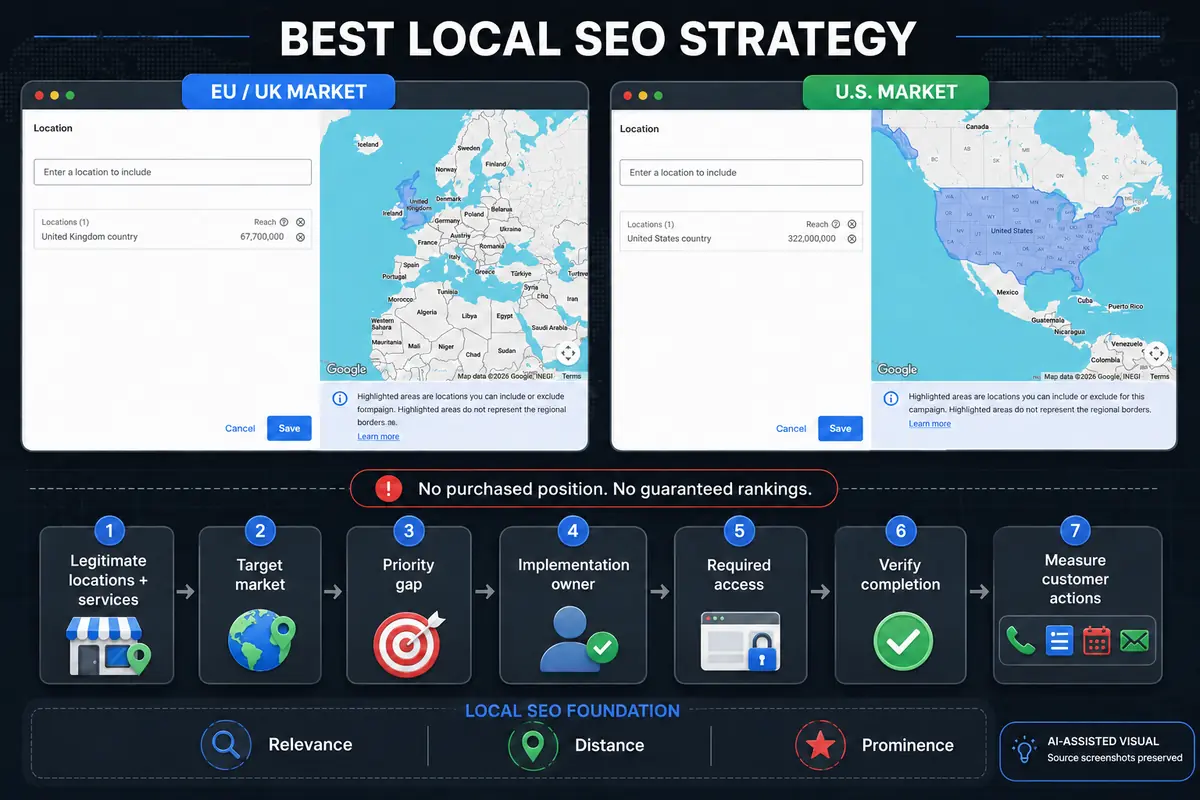
Google explains that local results are mainly based on relevance, distance and prominence. A provider cannot request or pay Google for a better local position.
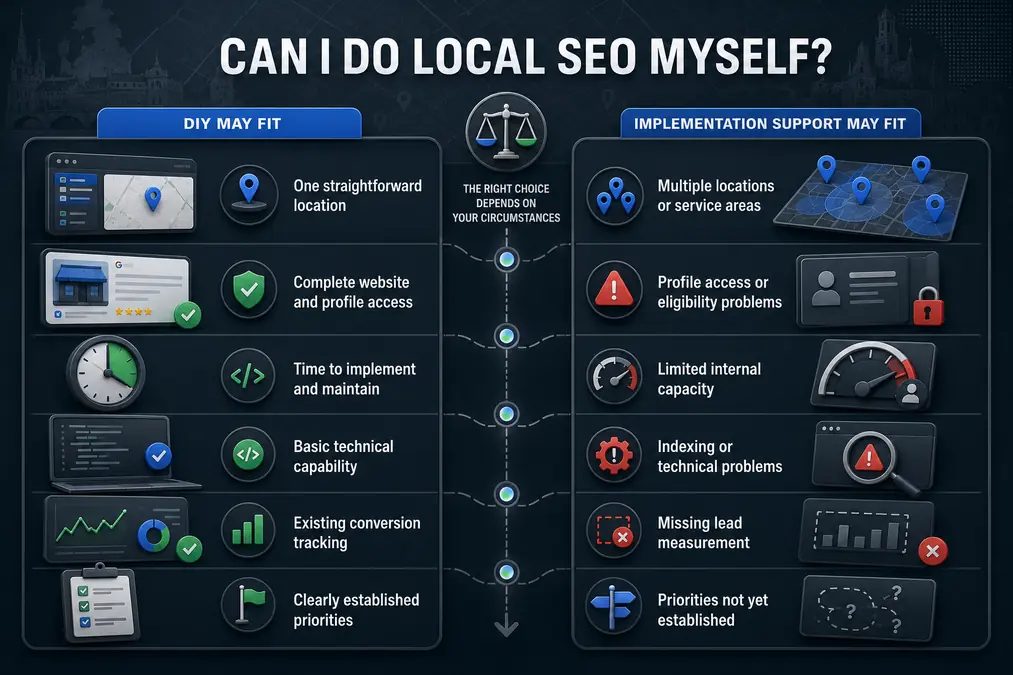
Can I Do Local SEO Myself for a Service Area Business?
You may be able to manage Local SEO internally when you control the website and Google Business Profile, understand your genuine service areas and have the time to implement and verify ongoing work.
Professional implementation may be more appropriate when your business targets several markets, has profile eligibility or suspension concerns, contains duplicated city pages, lacks conversion tracking or cannot maintain the campaign consistently.
| Internal implementation may fit | Professional implementation may fit |
|---|---|
| One principal service area | Several services or geographic markets |
| Correct GBP access and ownership | Profile access, eligibility or suspension concerns |
| Clear service and page ownership | Overlapping service and city pages |
| Time to maintain profile and website information | Limited internal capacity |
| Existing conversion tracking | Calls, forms or bookings are not measured |
| A documented implementation roadmap | Priorities have not been established |
This is an implementation-capacity decision, not a package comparison. Businesses evaluating commercial suitability can review Local SEO for Small Business. Companies comparing costs should use the Local SEO Pricing guide.
Local SEO Strategy for Service Area Businesses
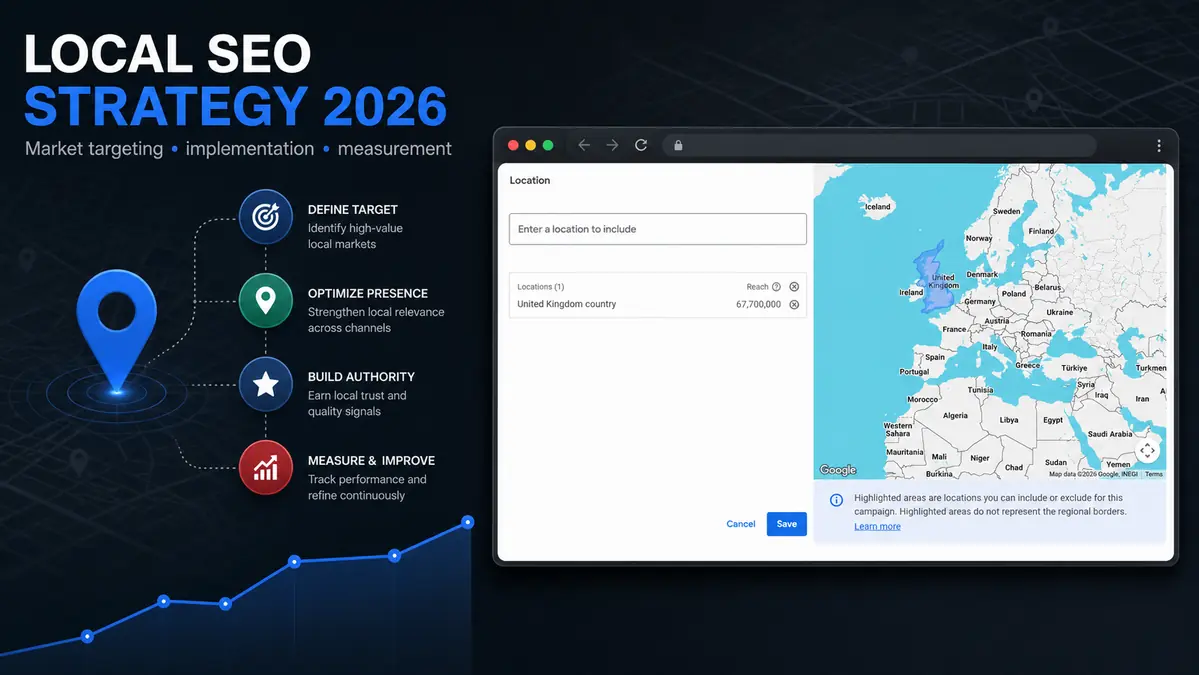
A Local SEO strategy for a service area business should identify which services and geographic markets have genuine commercial value before profile fields, pages or citations are changed.
A plumber serving five nearby cities needs a different roadmap from a clinic with one customer-facing office. The service area business must establish where it genuinely operates, which services it provides in each market and what evidence can support those claims.
The strategy should determine:
- Which services generate commercially relevant enquiries
- Which cities or regions the business genuinely serves
- Which market should receive attention first
- Whether the Google Business Profile represents the operating model correctly
- Which service and service area pages are required
- Which profile, website or technical problem limits visibility
- Who owns each implementation action
- How calls, forms, WhatsApp enquiries or booked jobs will be measured
The objective is not to claim the largest possible service area. It is to build the strongest legitimate relationship between the business, its services, its selected markets and the customers it can actually serve.
Prioritize the Local SEO Strategy
Not every identified issue deserves equal attention. Prioritize each action according to its commercial effect, implementation dependency and supporting evidence.
| Condition | Strategic priority | Appropriate response |
|---|---|---|
| Incorrect or ineligible GBP setup | Critical | Confirm eligibility and correct unsupported profile information |
| Calls or forms cannot be measured | Critical | Establish a usable baseline before evaluating commercial performance |
| Main service intent lacks a suitable page | High | Assign the intent to an existing or approved new service page |
| Several pages target the same service and market | High | Consolidate or separate ownership according to genuine intent |
| Important genuine service area lacks useful coverage | Medium–high | Assess whether a distinct service-area page is justified |
| Citation formatting differs across platforms | Medium | Verify whether the difference is genuinely inaccurate before changing it |
| Additional low-value city requested without evidence | Low/reject | Do not create the page solely to increase geographic coverage |
This matrix prevents the roadmap from becoming an unprioritized list of profile, content and citation tasks.
Account for Google Business Profile in the Strategy
Google Business Profile is one component of the Local SEO roadmap. At the strategy stage, determine whether the profile accurately represents the operating model, which issues require implementation and who is responsible for approved changes.
This section defines planning requirements. It does not replace a complete Google Business Profile optimization service or profile-management process.
If customers do not visit the operating address, the profile may need to hide that address and display the legitimate service area instead. The correct setup depends on the business model and Google’s current eligibility and representation guidelines.
Confirm Profile Eligibility and Operating Model
Before making changes, confirm:
- The business is eligible for a Google Business Profile
- The business name reflects its real-world identity
- The primary and secondary categories match genuine services
- The phone number and website are accurate
- The address should be displayed or hidden
- The selected service areas reflect locations the business actually serves
Define Genuine Service Areas
Adding a city or region to Google Business Profile does not automatically establish rankings in that market. Distance, competition, relevance, prominence and the business’s broader local evidence can still affect visibility.
Prioritize areas where the business:
- Regularly accepts customers
- Can provide its complete service
- Has commercially relevant demand
- Can support its claims with genuine business evidence
- Can realistically respond to enquiries
False addresses, virtual offices used only for ranking and locations the business does not genuinely operate from should not be used.
Local SEO Roadmap
A Local SEO roadmap converts the approved strategy into ordered, assigned and measurable implementation.
Discovery and Local SEO Audit
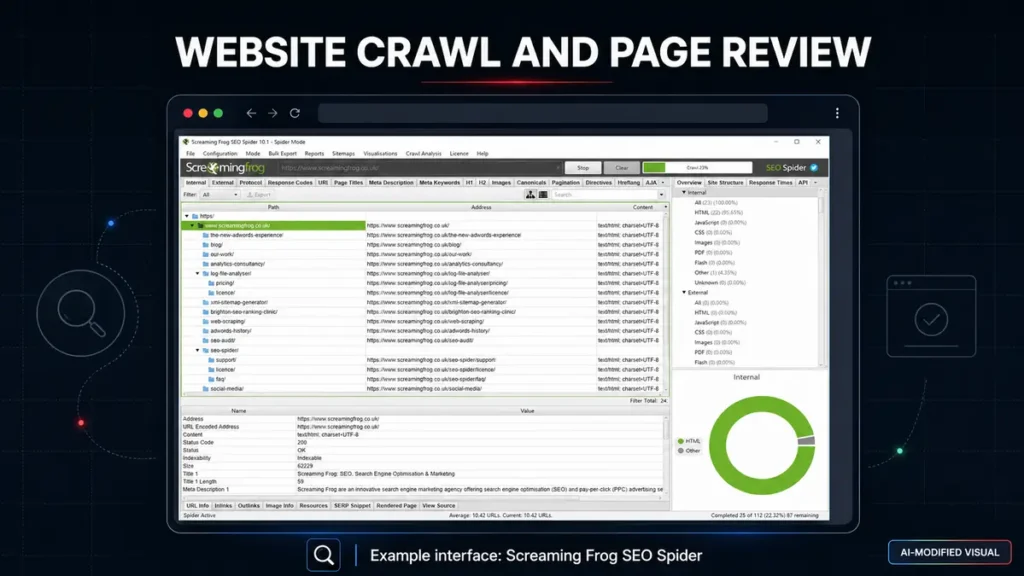
Use the discovery phase to confirm the operating model, genuine service areas, priority services, existing assets, visibility baseline and conversion paths. A complete diagnostic methodology belongs to the dedicated Local SEO Audit page.
Google Business Profile Optimization
Correct only the profile elements supported by accurate business information and the approved strategy.
Website and Service Area Pages
Assign one clear intent to each service or geographic page. Improve existing pages before creating additional pages that may compete for the same search intent.
Reviews, Citations and Local Backlinks
Strengthen legitimate third-party signals through accurate listings, genuine customer reviews and relevant local relationships.
Reporting and Conversion Tracking
Track completed implementation alongside relevant impressions, calls, forms, bookings and WhatsApp enquiries where technically possible.
| Phase | Priority | Completion evidence |
|---|---|---|
| Days 1–14 | Confirm business model, services, target areas and tracking | Approved scope and baseline |
| Days 15–30 | Resolve priority GBP and website issues | Change log and screenshots |
| Days 31–60 | Improve priority service and service area pages | Published or updated pages |
| Days 61–90 | Strengthen trust signals and evaluate response | Reporting comparison and next actions |
These are implementation phases—not guaranteed ranking or lead timelines.
Service Area Pages
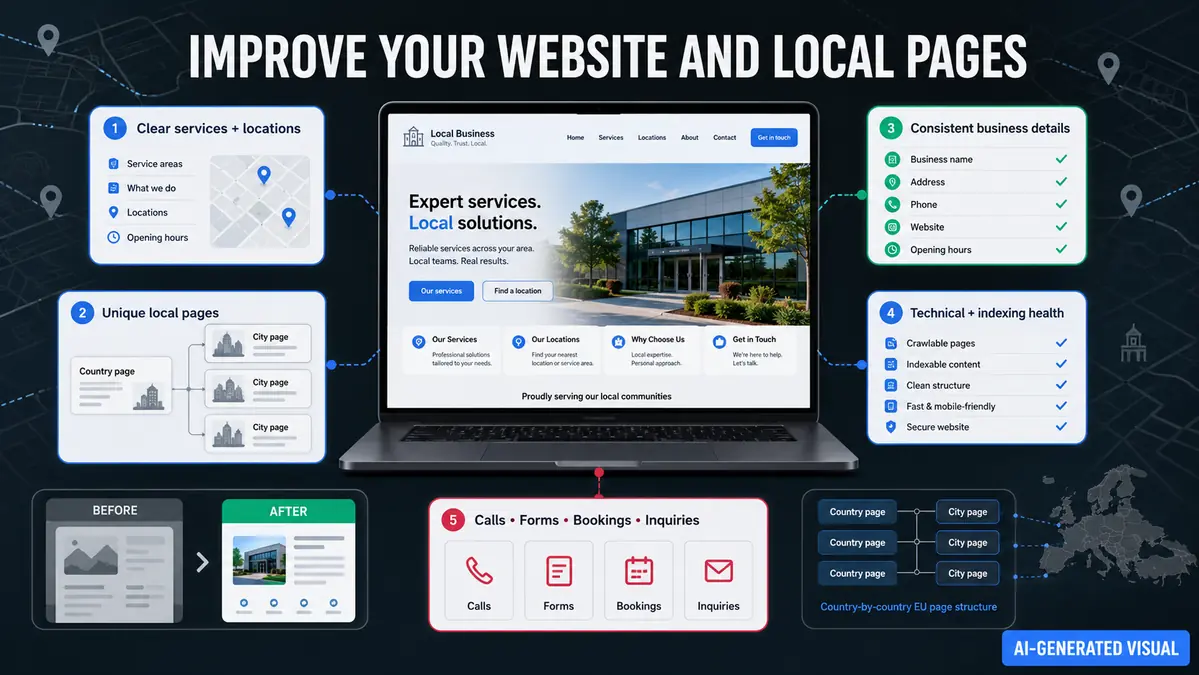
Service area pages are landing pages created for genuine geographic markets that a business serves. They should help potential customers understand what is available in that area and why the company is a relevant choice.
Create Unique Service Area Pages
Before creating a service area page, confirm:
- The company genuinely serves that location
- There is relevant search and commercial demand
- The page has a distinct geographic purpose
- Useful local information or evidence is available
- The page has a clear call, form or booking path
- Another page does not already own the same intent
Avoid Duplicate Location Pages
Do not create substantially identical pages by replacing only the city name. Each selected page should contain meaningful information relevant to the service, market and customer decision.
Useful differentiators may include:
- Services genuinely available in that area
- Relevant project or service evidence
- Travel, scheduling or availability information
- Applicable regulations or market conditions
- Area-specific FAQs
- A suitable conversion path
Separate Service Pages from Service Area Pages
A main service page should own the core service intent. A service area page should explain the availability and relevance of that service in a genuine geographic market.
Do not create both pages if they would substantially repeat the same purpose and content.
Local Citations, Reviews and Local Backlinks
Citations, reviews and local backlinks can help establish the accuracy and prominence of a service area business, but they should support a legitimate operating model rather than compensate for false or inconsistent location claims.
Local Citations
Keep the business name, address where appropriate, phone number and website consistent across important directories and business profiles. Investigate apparent discrepancies before changing them because different platforms may format legitimate information differently.
Customer Reviews
Encourage genuine customers to leave honest reviews without requiring particular wording or sentiment. Respond professionally and do not publish fabricated reviews.
Reviews may support trust and customer decisions, but no specific number or review wording can guarantee rankings.
Local Backlinks
Relevant local links may come from genuine professional associations, Chambers of Commerce, suppliers, regional publications, sponsorships or community relationships.
Evaluate relevance and legitimacy rather than purchasing large quantities of low-quality directory links.
Local SEO Strategy Example for a Service Area Business
Consider an HVAC contractor serving one principal city and four surrounding areas.
A weak strategy might add every city to Google Business Profile and publish five substantially identical landing pages. This creates activity, but it does not establish why the company is relevant in each market.
A stronger strategy would:
- Confirm the areas the contractor genuinely serves.
- Identify the services with the strongest commercial importance.
- Review Google Business Profile eligibility, categories and service-area settings.
- Assign the main HVAC service intent to the appropriate core page.
- Select only geographic pages that can provide distinct customer value.
- Connect those pages through useful internal links.
- Strengthen genuine reviews, citations and local evidence.
- Measure calls, forms and booked appointments by source where technically possible.
This is an illustrative strategy scenario—not a WebCoreShop client case study, testimonial or promised outcome.
Local SEO Strategy Checklist
A local SEO checklist should convert the approved roadmap into assigned and measurable work. It should not repeat the diagnostic categories owned by the Audit page.
| Checklist field | Required information |
|---|---|
| Business objective | The commercial problem the action should support |
| Priority | Critical, high, medium or low |
| Approved action | Exact work to be completed |
| Intent owner | GBP, service page, service-area page or another asset |
| Responsible owner | Person or team accountable for completion |
| Required access | Account, website or business information needed |
| Deadline | Intended completion date |
| Completion evidence | URL, screenshot, report or verified change |
| KPI | Measurement connected to the action |
| Limitation | Missing information or factor outside control |
| Review date | Date for reassessment |
| Next decision | Continue, revise, expand, pause or close |
“Improve Google Business Profile” is not a useful checklist task because it does not define the required action. A better entry identifies the approved change, owner, deadline, evidence and measurement.
How to Measure Local SEO Success
A Local SEO strategy should be evaluated using implementation, visibility and commercial-response data together. An increase in impressions alone does not establish that the campaign is generating suitable business opportunities.
Google Maps Visibility
Monitor location-dependent visibility for commercially relevant services. Geo-grid results should be interpreted in context because the displayed position can change according to the searcher’s location.
Local Search Rankings
Track relevant service-and-location queries rather than relying on one sitewide average position. Separate branded, non-branded, service and geographic queries where sufficient data is available.
Calls, Forms and Booked Jobs
Where tracking is technically possible, measure:
- Qualified phone calls
- Form submissions
- WhatsApp enquiries
- Appointment requests
- Confirmed booked jobs
- Lead quality by service and geographic market
Establish a baseline and use a consistent comparison period. Rankings, calls, leads, bookings and revenue cannot be guaranteed.
Local SEO Strategy PDF and Template
A useful local SEO strategy PDF should help a business organize implementation without repeating a complete audit or managed-service proposal.
The accompanying local SEO strategy template should contain:
.rather than repeat a complete audit or service proposal.
The accompanying local SEO strategy template should contain:
- priority;
- approved action;
- owner;
- deadline;
- evidence;
- KPI;
- review date;
- implementation notes.
Use the resource after the company’s priorities have been established. It should show which actions can be completed internally and where professional implementation may be necessary.
Download the Local SEO Strategy PDF and template to organize your work.
The template is an implementation-planning resource. It does not guarantee rankings, traffic or commercial outcomes.
- References
- Google Business Profile Help: Tips to improve your local ranking
- Google Business Profile Help: Guidelines for representing your business
- Google Business Profile Help: Edit your Business Profile
- Google Search Central: LocalBusiness structured data
- Google Search Central: Technical requirements
- Google Search Central: Structured-data guidelines
Image source: Screaming Frog SEO Spider. AI-modified presentation; not a WebCoreShop or client result. screamingfrog - SEO Starter Guide
- Google Business Profile Help
- Creating Helpful, Reliable, People-First Content