Prepared and reviewed by: Ayman Altair, WebCoreShop owner and Local SEO practitioner
Expertise: Small Business Search Marketing; Google Maps and Business Profile Optimization
Business status: Independent freelance digital-services provider based in Türkiye
Contact: contact@webcoreshop.com
Reviewed: September 4, 2026
Estimated reading time: 6–8 minutes
⚡ Quick Answer
Local SEO for service-area businesses (SABs) is the process of optimizing a business that delivers goods or travels to clients directly at their location. Because the physical operating address is hidden on Google Maps, visibility depends on:
-
Address-Hidden GBP Optimization: Setting up to 20 realistic service zones within a 2-hour driving limit.
-
True Operating Proximity: Acknowledging that Google calculates local rank from your physical verification base—not your designated service area boundaries.
-
Local Page Architecture: Building dedicated, proof-backed area pages with valid Service and areaServed structured data instead of duplicate doorway pages.
On this page: Service-business SEO · Google Maps · Service areas · Verification · Business models · Choosing a service
Key Takeaways at a Glance
-
Verification: Requires unedited video proof showing branded gear, tools, and access to work vehicles—PO boxes and virtual offices are auto-suspended.
-
Proximity Reality: Hiding your address does not grant a city-wide centroid; visibility naturally drops as distance from your registered base increases.
-
Doorway Page Policy: Every city page must include unique proof of work (photos, local permits, distinct client reviews) to prevent algorithmic deindexing.
Request a service-area visibility assessment through WhatsApp.
Local SEO for Service Businesses
Local SEO for service businesses covers the broader work needed to improve visibility, customer actions and reporting across local search. Review WebCoreShop’s Local SEO services for the complete offer, deliverables and general service boundaries.
This page focuses on businesses that travel to customers. WebCoreShop connects their operating model, address visibility, priority services, legitimate coverage, page ownership and conversion paths while improving or consolidating existing assets before proposing new pages.
Local SEO for Service-Area Businesses Google Maps
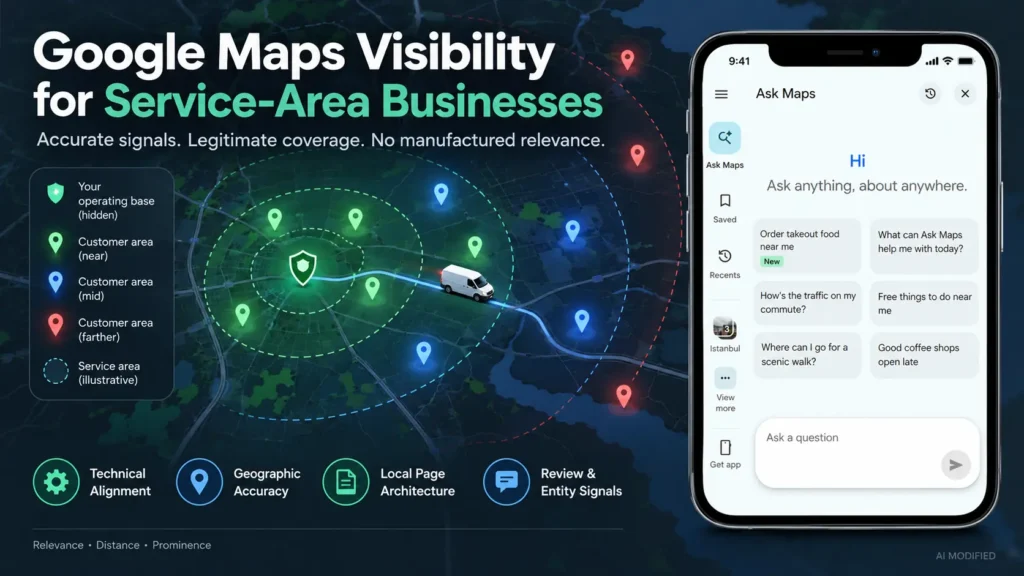
Google Maps visibility for service-area businesses requires accurate geographic signals, a legitimate operating model and a website that supports the same services and coverage.
A legitimate service-area business can appear in Google Maps without displaying a public storefront when its Business Profile accurately represents a company that travels to customers. Hiding the address does not remove the need to provide Google with an accurate operating location or complete the verification Google requires.
Google explains that local results are mainly based on relevance, distance and prominence. Distance considers how far a result is from the location used in the search. For a hidden-address business, entering more service areas does not move its verified operating base or create new locations; visibility commonly weakens as searchers get farther from that base. Google does not publicly describe this as a guaranteed “centroid” formula. No provider can request or pay Google for a better local ranking.
Selecting a city as a service area does not guarantee visibility there. Searcher location, competition, relevance, accuracy and prominence still affect results.
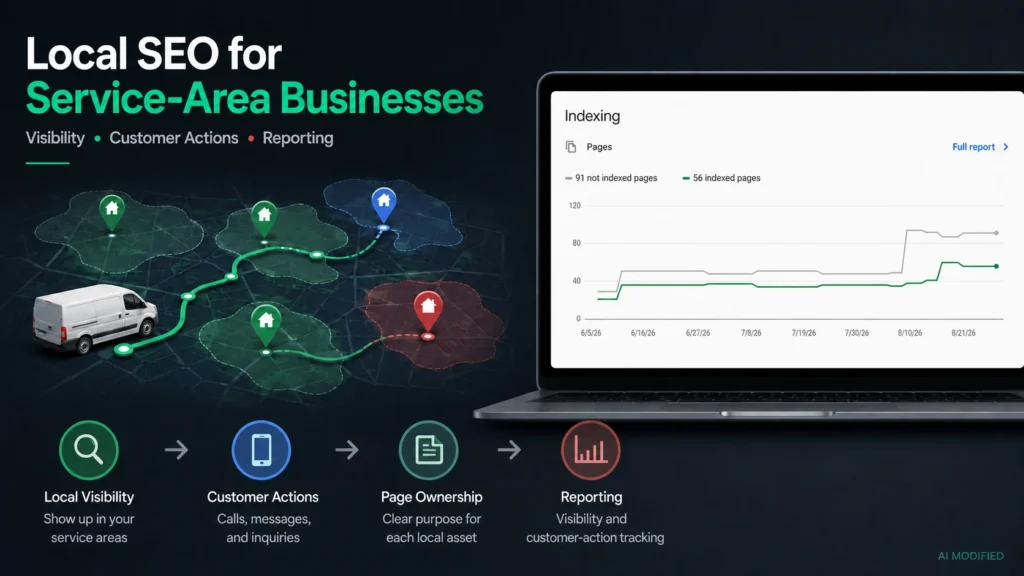
The service connects four practical delivery areas:
Technical and structured-data alignment: Review crawlability, indexability, canonical signals, mobile usability, page relationships, and supported JSON-LD structured data.
-
Business Profile and geographic accuracy: Check eligibility, address visibility, categories, services and genuine coverage without treating selected areas as guaranteed ranking zones.
-
On-page local architecture: Assign each service and geographic intent to one useful page, connect relevant pages and maintain a clear enquiry path.
-
Review and entity signals: Support the business identity through genuine reviews, verifiable information and accurate citations. For a hidden residential base, use only directories that support address suppression; verify the public result so the address is not exposed.
Unsupported locations are not used to manufacture relevance.
Google Business Profile Service Area
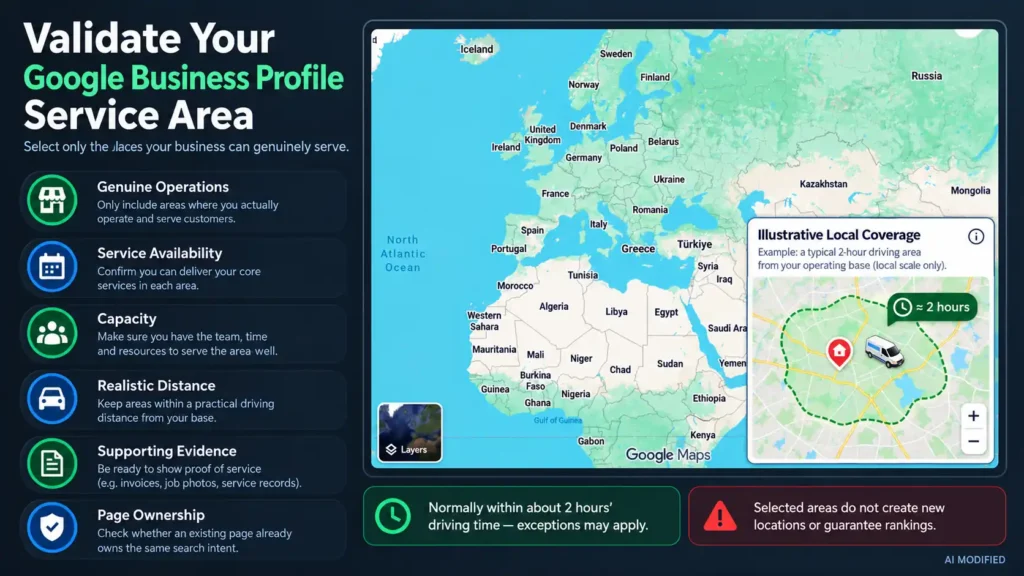
A Google Business Profile service area should describe where the company genuinely travels to serve customers. Google allows service areas to be represented with available geographic units such as cities or postal codes, but the selected coverage must remain accurate and specific.
Adding more areas does not create additional business locations or guarantee rankings across them. Google’s current representation guidelines say that the overall service-area boundary normally should not extend farther than approximately two hours of driving time from the business base, although some business models may justify broader coverage.
WebCoreShop checks whether every selected area matches operating capacity, services offered, website claims and customer demand. An area should not remain in the campaign merely because the company wants visibility there. The business needs to be able to accept, schedule and complete the promoted service for customers in that market.
| Validation factor | Decision question |
|---|---|
| Genuine operations | Does the company regularly serve customers in this area? |
| Service availability | Are the promoted services genuinely available there? |
| Capacity | Can the business respond to suitable enquiries? |
| Distance | Is travel realistic from the operating base? |
| Evidence | Can the geographic claim be supported without exposing customer data? |
| Page ownership | Does an existing page already own the same search intent? |
How to Verify a Service Area Business on Google
To verify a service-area business on Google, claim its Business Profile, select the verification method Google makes available and provide evidence of the location, business operation and your authority to manage it. Google determines which verification methods are offered.
Verification options depend on the business and region. Use only the methods displayed on that specific Google Business Profile.
📹 Google Video Verification: Step-by-Step Blueprint
(Google requires one continuous, uninterrupted recording under 2 minutes. Any pause, cut, or edit results in an immediate failure.)
-
Phase 1: Location & Street Proof (0:00 – 0:30)
Stand on the street outside your operating base. Slowly capture the permanent street name sign, the building/house number, and surrounding landmarks. Ensure your smartphone’s GPS location is turned ON. -
Phase 2: Operational Equipment & Fleet (0:30 – 1:00)
Walk steadily to your work vehicle or workspace. Frame your permanent vehicle decals, branded uniforms, trade tools, diagnostic devices, or marketing supplies. (Avoid temporary magnetic car signs, as they trigger review flags). -
Phase 3: Proof of Authority & Keys (1:00 – 1:30)
Physically unlock your work vehicle or facility door with your keys on camera. Show paper invoices, business registration documents, or trade licenses matching your exact legal business name.
⚠️ Critical Safeguards:
• Do not film bystanders’ or clients’ faces.
• Do not expose unredacted bank account numbers or credit cards.
• Never record at a virtual office (e.g., Regus) or a PO Box facility.
Service Area Business Examples
Service-area business examples include plumbers, electricians, cleaners, roofers, locksmiths, mobile technicians, landscapers and pet-care providers that travel to customers instead of receiving them at their operating address. Google uses plumbers and pet walkers as examples of this model.
A hybrid business serves customers at a staffed location and also travels or delivers to them. Google gives an auto repair shop offering roadside assistance as an example. Its address may be displayed only when customers can visit during stated hours and the location satisfies Google’s requirements.
Business type should follow real operations rather than the visibility the company wants. A contractor working from home may need a hidden address. A staffed showroom that receives customers may qualify as a storefront or hybrid business. An online-only company that does not make in-person contact with customers generally is not eligible for a Business Profile.
| Operating model | Customers visit? | Business travels? | Typical profile treatment |
|---|
| Service-area business | No | Yes | Address normally hidden; genuine service areas added |
| Storefront | Yes | Not required | Eligible staffed address may be displayed |
| Hybrid | Yes | Yes | Eligible address and service areas may be used |
| Online-only | No | No in-person service | Generally not eligible for a Business Profile |
Choose the correct operating model
- Customers do not visit the address, but the business travels to them: Use the service-area model and normally hide the address.
- Customers visit a staffed location and the business also travels to them: Assess the business as a hybrid.
- Customers visit a staffed location only: Assess the business as a storefront.
- No in-person customer contact occurs: The business is generally ineligible for a Google Business Profile.
Classification must follow real operations—not the location or visibility the business wants.
Best Local SEO for Service Area Businesses
The best Local SEO for service area businesses is a campaign matched to the company’s genuine operating model, commercially important services, realistic coverage and capacity to respond to enquiries. It should not promise top rankings or manufacture locations the business cannot support.
A suitable provider should confirm eligibility, ownership, page intent, geographic evidence, conversion tracking, responsibilities and exclusions. Recommendations should distinguish verified facts from automated detections and explain each action and its validation.
WebCoreShop defines the approved services, geographic areas, website pages, Business Profile responsibilities, reporting, access requirements and exclusions in writing. Existing assets are improved or consolidated before additional pages are proposed.
A legitimate city or county page needs a distinct customer purpose and local proof—not a city-name swap. Useful evidence may include permits, utility or jurisdiction boundaries, service availability, travel constraints and authorized project evidence. Without distinct value, improve an existing owner page instead of publishing repetitive geographic pages that could resemble doorway abuse under Google’s spam policies.
The correct scope depends on existing assets, competition, evidence and implementation capacity. No provider or package is automatically best for every company. Compare WebCoreShop’s Local SEO pricing and package options after confirming the services, geographic coverage and implementation work your business requires. . An assessment should establish:
-
Which services should generate qualified enquiries
-
Which areas the business genuinely serves
-
Whether the address and profile represent the operating model correctly
-
Which website page owns each search intent
-
Whether calls, forms and WhatsApp enquiries can be measured
-
Required client information and access
-
WebCoreShop’s tasks, exclusions and limitations
Required inputs include the website, Business Profile, services, service areas, access, duplicate pages, operational evidence and conversion methods. Private customer information must be removed.
FAQ
Can I rank in Google Maps if my address is hidden?
Yes. An eligible service-area business can appear with its address hidden, but visibility still depends on relevance, distance, prominence and competition. Adding service areas does not guarantee rankings in them.
Why does my service-area business only rank near my home base?
Proximity remains part of local ranking. Visibility often declines as searchers move farther from the verified operating base, even when the profile lists their city as a service area.
Can I use a PO Box or UPS Store to verify my profile?
Do not use a PO Box, remote mailbox or location where the business does not genuinely operate. Use the real operating location and follow the verification options Google provides.
Identify Your Service-Area Ranking Blockers
Send your business name and current coverage area to Ayman Altair for a manual inspection of your 2-hour driving boundaries, citation consistency, and video verification readiness.
👉 Request Visibility Assessment via WhatsApp →