
📉 If your website revenue dropped after core update, you are not alone.
Each Google core update recalibrates ranking systems, reshuffles visibility, and indirectly reshapes revenue streams across organic, ecommerce, affiliate, and advertising models.
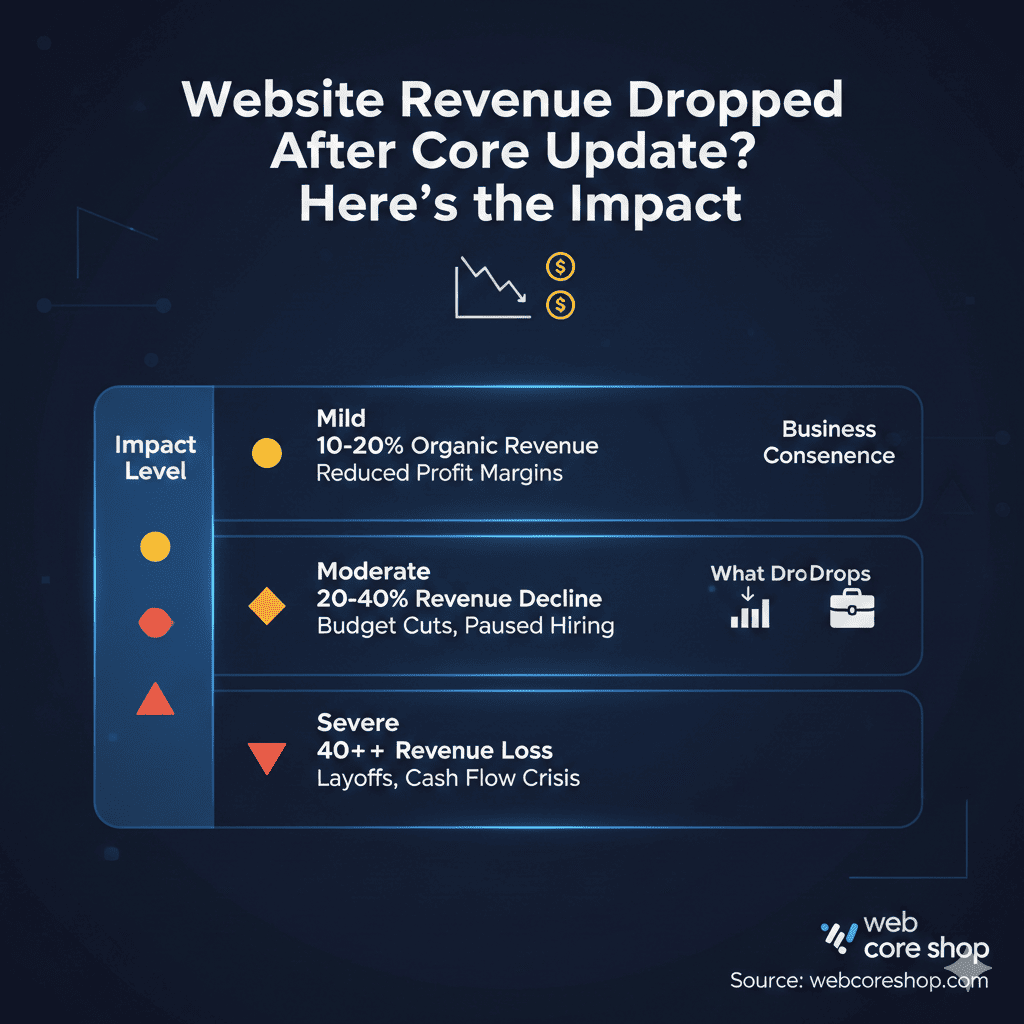
| Impact Level | What Drops | Business Consequence |
|---|---|---|
| 🟡 Mild | 10-20% organic revenue | Reduced profit margins |
| 🟠 Moderate | 20-40% revenue decline | Budget cuts, paused hiring |
| 🔴 Severe | 40%+ revenue loss | Layoffs, cash flow crisis |
A drop in rankings is frustrating.
A drop in revenue is critical.
This pillar guide addresses:
✅ Why revenue decline happens after a core update
✅ How to diagnose revenue loss at page and channel level
✅ How to stabilize performance before the next update
✅ What recovery architecture looks like (traffic + revenue + CRO)
Whether you’re experiencing declining income after an algorithm change, reduced organic revenue, or specific monetization challenges like ecommerce or affiliate income loss, this guide provides a structured, business-first response plan.
🚨 Lost traffic after the update?
👉Get a free recovery opinion in 5 minutes on WhatsApp:
Quick Wins Box: 3 Things You Can Do in the Next 60 Minutes
Find Your Money Pages: In GA4, sort by “Revenue” and identify the top 5 pages that lost the most income. These are your #1 priority.
Check Your CTR: In Google Search Console, compare your top revenue pages’ average CTR before and after the update. A drop here signals a SERP psychology problem—your title/description no longer compels clicks.
Add a “Promise” to Your Main CTA: Change a generic “Contact Us” button to something with specificity and power words, like: “Get Your Step-by-Step Diagnosis & 90-Day Recovery Plan.”
What Is the Concept of a Google Core Update?
A Google core update is a broad algorithmic change that re-evaluates how content quality, relevance, authority, and user satisfaction are assessed across search results.
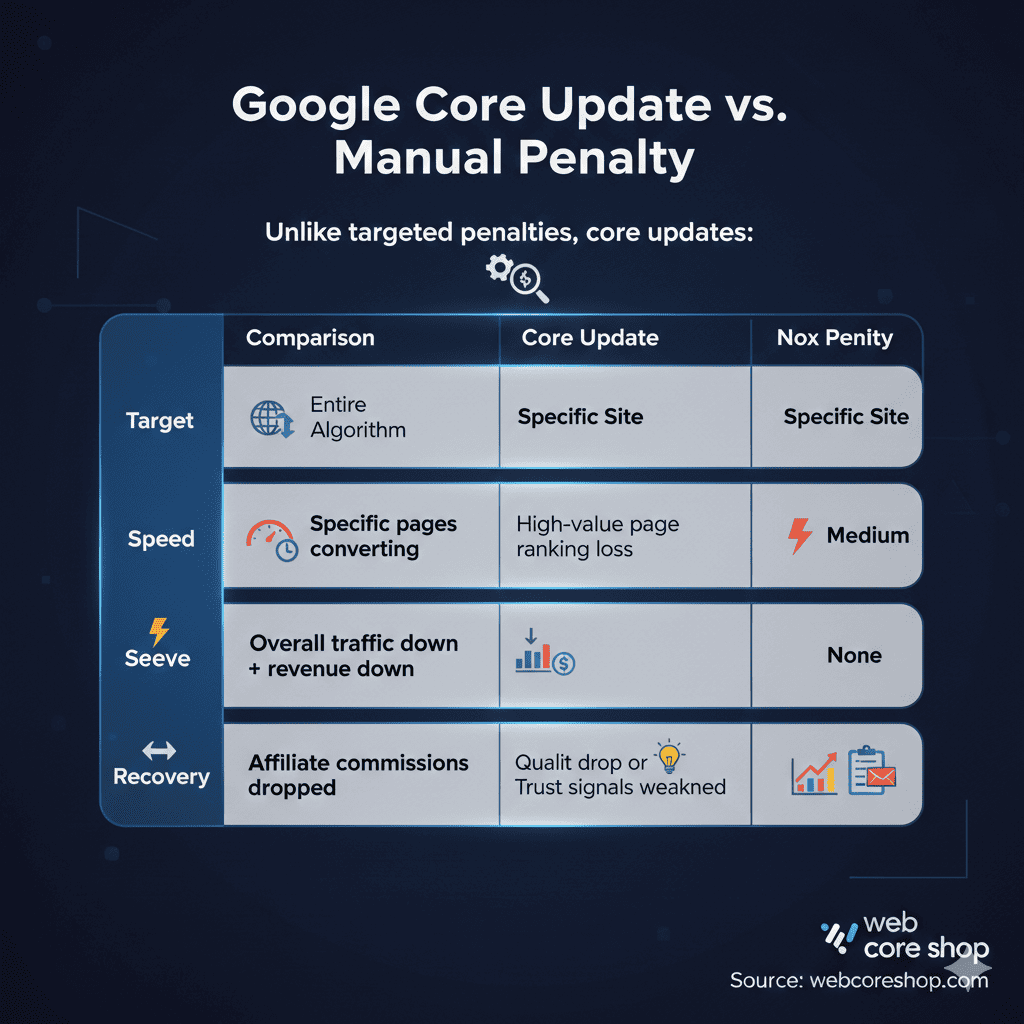
Unlike targeted penalties, core updates:
| Comparison | Core Update | Manual Penalty |
|---|---|---|
| 🎯 Target | Entire algorithm | Specific site |
| ⚡ Speed | Gradual rollout | Immediate |
| 📋 Notification | None | Google Search Console |
| 🔄 Recovery | Quality improvements | Reconsideration request |
Instead, they reassess overall ranking signals, often impact large portions of the index, and can affect rankings even when no technical errors exist.
Core updates frequently evaluate:
📊 Content depth and usefulness
🔍 E-E-A-T signals
🏛️ Site-wide quality indicators
👥 User engagement metrics
🎯 Search intent alignment
According to Google Search Central, core updates are designed to “better assess content overall” and ensure users see more reliable, helpful information in search results.
When rankings shift, traffic shifts.
When traffic shifts, income follows.
Expert Insight: “Core updates are comparative quality recalibrations. Thresholds rise. Stronger pages replace weaker ones. Revenue recovery is not about ‘gaming’ the algorithm—it is about aligning with how Google now evaluates value.” — Daniel Mercer, Technical SEO Strategist
Not sure what caused your drop?
👉Send your site on WhatsApp and I’ll tell you the likely reason:
The Core Revenue Impact Framework
When website income decreased after Google update, the issue is rarely isolated to “rankings.”
Revenue decline after algorithm updates is multi-layered.

Understanding this chain prevents reactive decisions.
According to Search Engine Land, estimates suggest Google’s Search Generative Experience (SGE) could result in a 20% to 60% decline in organic search traffic, potentially causing up to $2 billion in lost digital ad revenue annually.
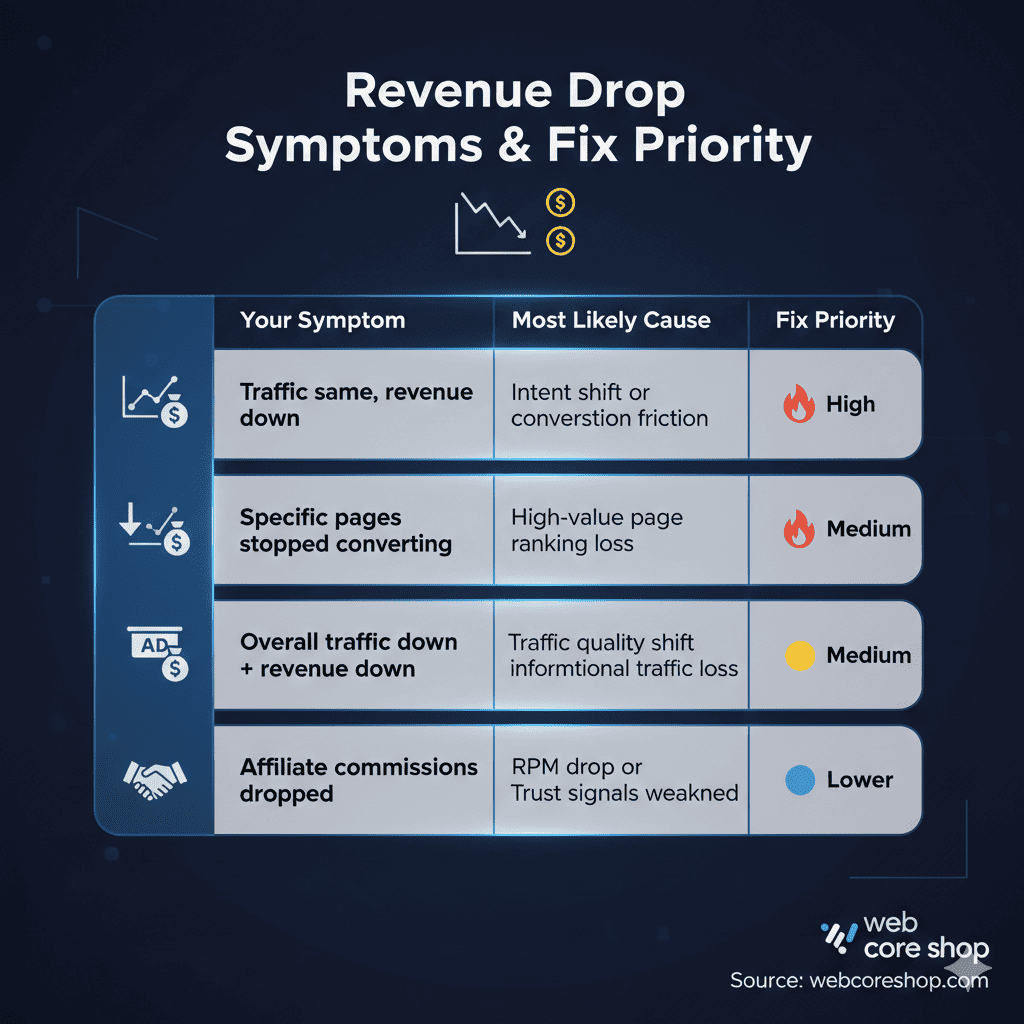
Revenue Drop After Google Update: 5 Root Causes
🔍 Root Cause Comparison Matrix
| Root Cause | Traffic Impact | Revenue Impact | Detection Method |
|---|---|---|---|
| 1. Traffic Quality Shift | 🟡 Same volume | 🔴 High loss | Buyer-intent keyword analysis |
| 2. High-Value Page Loss | 🟡 Page-level | 🔴 Concentrated | Revenue by page report |
| 3. Intent Reclassification | 🟢 Minimal | 🟠 Moderate | SERP comparison |
| 4. E-E-A-T Reweighting | 🟠 Gradual | 🟠 Gradual | Authority audit |
| 5. Conversion Friction | 🟢 Stable | 🔴 Sudden | Funnel analysis |
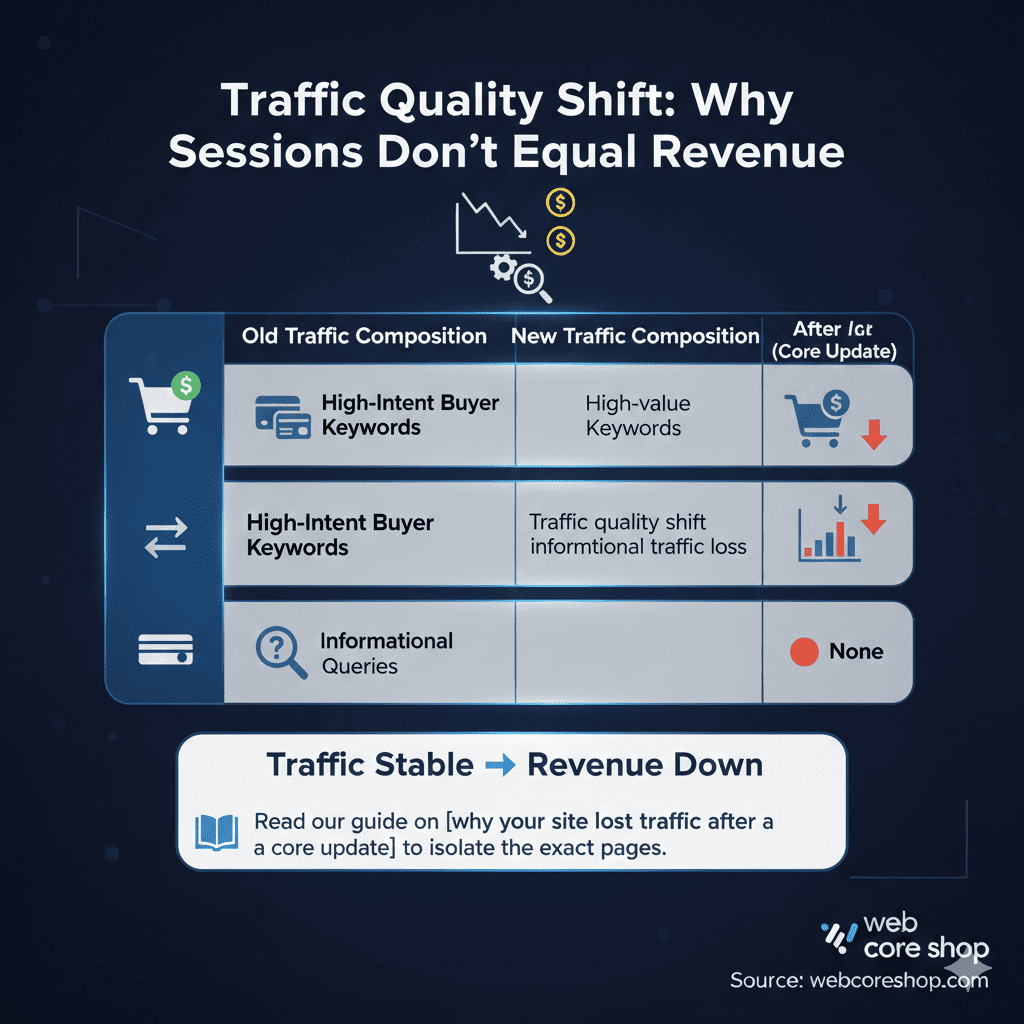
1. Traffic Quality Shift
Even if overall visitor numbers appear stable, the composition of that traffic may have fundamentally changed.
Buyer-intent keywords often drop first, while informational queries may hold steady or even increase.
High-converting pages frequently lose visibility without warning.
This explains why some site owners notice a decline in organic revenue even when total sessions look healthy.
Before you can diagnose revenue, you must understand if your overall sessions dropped.
📖 Read our guide on why your site lost traffic after a core update to isolate the exact pages.
Academic Research Insight: A 2025 study published in Information Systems on personalized information retrieval confirms that user intent alignment significantly impacts search effectiveness.
Knowledge graph-based models improve retrieval accuracy by up to 10% over baseline methods.
2. High-Value Page Ranking Loss
When revenue by page declines after an update, the losses typically concentrate in specific areas.
| Page Type | Risk Level | Typical Revenue Impact |
|---|---|---|
| 🛒 Product pages | 🔴 High | Direct sales loss |
| 💰 Money pages | 🔴 High | Conversion drop |
| 🔗 Affiliate comparisons | 🟠 Medium | Commission loss |
| 📝 Lead-gen landing pages | 🟠 Medium | Pipeline reduction |
If your most commercially valuable content lost visibility, you likely have a structural relevance issue that requires targeted attention.
If specific money pages stopped converting, check if you have lost keyword rankings after the 2026 core update for high-intent commercial terms.
3. SERP Intent Reclassification
Google may now prefer more authoritative brands, more in-depth guides, different content formats, or fresher information.
Your page may still rank—but no longer satisfies updated intent modeling.
| Intent Type | Old Preference | New Preference |
|---|---|---|
| Commercial | Product lists | Expert comparisons |
| Informational | Quick answers | Comprehensive guides |
| Transactional | Direct buy | Trust + social proof |
This explains why some sites experience declining income after an algorithm change despite maintaining similar search positions.
Industry Data: Raptive’s research analyzing top traffic-driving keywords indicates an average traffic loss of 25% when SGE is fully implemented.
Marc McCollum, Raptive’s Executive Vice President of Innovation, notes this represents “a substantial threat to digital publishing’s financial stability.”
4. E-E-A-T Reweighting
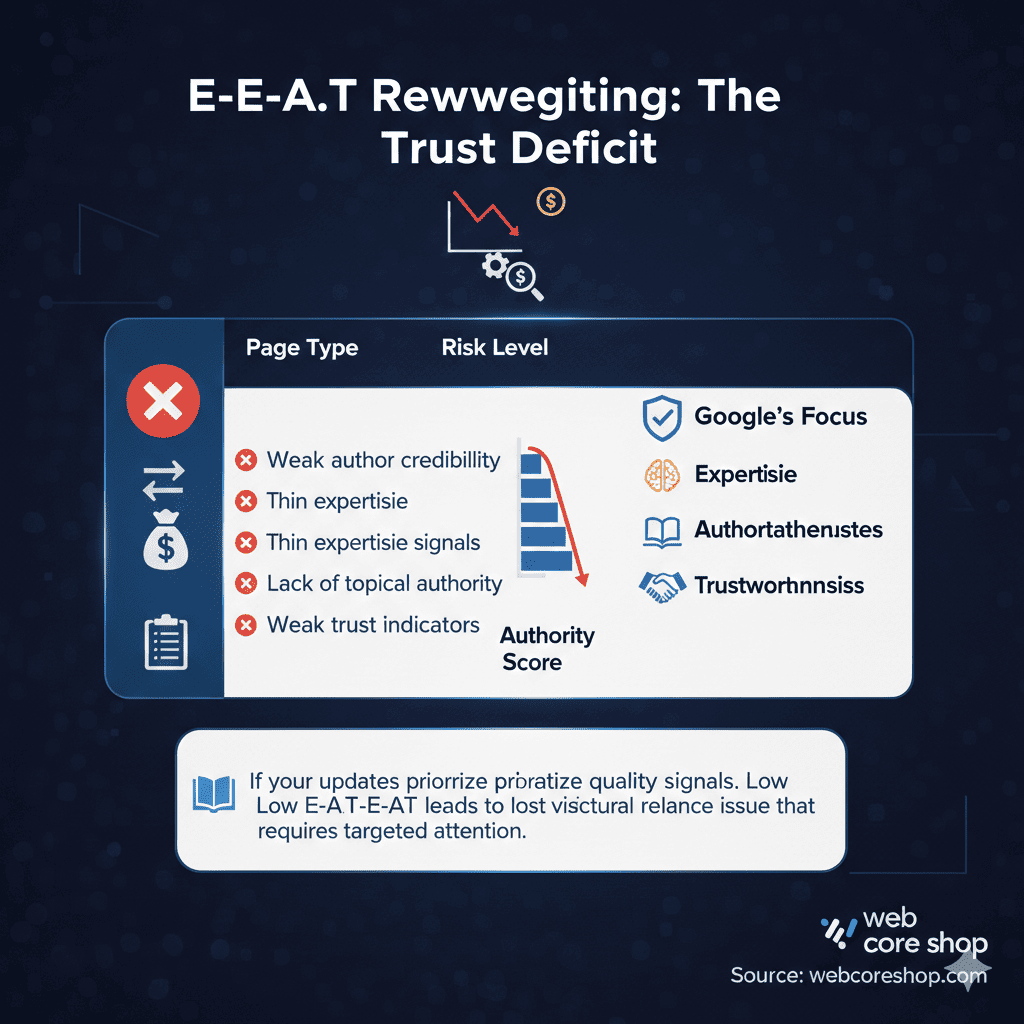
Revenue decline after core update often correlates with:
❌ Weak author credibility
❌ Thin expertise signals
❌ Lack of topical authority
❌ Weak trust indicators
Google’s quality rater guidelines emphasize these factors, and core updates frequently adjust how heavily they are weighted.
E-E-A-T Self-Assessment Checklist
Do your authors have visible credentials?
Is methodology clearly explained?
Are trust signals (reviews, testimonials) present?
Does content demonstrate first-hand experience?
Are external citations from authoritative sources included?
Want a step-by-step recovery plan for your site?
👉 Message me directly here:
5. Conversion Friction
Sometimes traffic remains stable but user expectations have changed.
Layout may disrupt intent, calls-to-action may misalign, or the funnel path may break.
This explains sudden revenue drop after Google update even when rankings did not collapse.
| Friction Point | Detection Method | Fix |
|---|---|---|
| ⚡ Slow load time | Core Web Vitals | Optimize images, server |
| 📱 Poor mobile UX | Mobile usability report | Responsive redesign |
| 🔗 Broken funnel | GA4 funnel analysis | Fix internal links |
| 🎯 Weak CTA | Heatmaps | A/B test buttons |
Visitors arrive but no longer convert at previous rates.
If you’re facing Google core update revenue impact, follow this structured diagnostic sequence.
Step 1: Segment Revenue by Channel
Analyze in GA4:
| Channel | Pre-Update Revenue | Post-Update Revenue | Change |
|---|---|---|---|
| 🟢 Organic Search | $XX,XXX | $XX,XXX | █████ |
| 🔵 Paid Search | $XX,XXX | $XX,XXX | █████ |
| 🟣 Direct | $XX,XXX | $XX,XXX | █████ |
| 🟡 Referral | $XX,XXX | $XX,XXX | █████ |
Look for shifts in traffic sources and conversion rate changes by channel.
Pay special attention if organic revenue declined while other channels remained stable—this confirms an SEO-specific impact.
SEMrush data from Q3 2025 shows that enterprise customers are increasingly focusing on revenue per session metrics.
AI products contributed $10 million in ARR during the quarter—more than doubling from Q2 to Q3.
Step 2: Identify Pages Causing Revenue Drop After Update
Pull revenue by page, sessions by page, conversion rate by page, and assisted conversions.
Page-Level Revenue Impact Template
| Page URL | Pre Sessions | Post Sessions | Pre Revenue | Post Revenue | Change |
|---|---|---|---|---|---|
| /product-a | 10,000 | 4,000 | $50,000 | $20,000 | -60% |
| /guide-b | 25,000 | 22,000 | $5,000 | $4,500 | -10% |
| /comparison-c | 8,000 | 7,500 | $40,000 | $15,000 | -62.5% |
Look for:
🔴 High-revenue pages that lost rankings
🟡 Pages with traffic but conversion drops
🔵 Pages overtaken by competitors
Expert Insight: Lisa Wendland, MBA, an ecommerce SEO specialist, noted after the December 2025 Core Update: “Sites with thin content dropped; strong E-E-A-T winners stabilized or gained.”
“The update reinforces Google’s push for helpful, high-quality content that truly satisfies commercial intent, especially as AI-driven search reshapes buyer behavior.”
Step 3: Compare Pre- and Post-Update Intent
Ask whether the SERP layout changed, whether top results are more authoritative, and whether content depth has significantly increased.
SERP Intent Comparison Tool
| Factor | Your Page | Top Competitor | Gap |
|---|---|---|---|
| 📏 Depth | ████████░░ 80% | ██████████ 100% | -20% |
| 🔍 Authority | ██████░░░░ 60% | ██████████ 100% | -40% |
| 📊 Data/Proof | ████░░░░░░ 40% | ██████████ 100% | -60% |
| 🧠 Expertise | ███████░░░ 70% | ██████████ 100% | -30% |
Consider whether format preferences have shifted toward video, lists, or tools.
This analysis reveals whether your content still matches what Google considers the best format for each query.
Step 4: Diagnose Revenue Loss After Google Algorithm Update by Model
Ecommerce Revenue Dropped After Core Update
Check category versus product page shifts, commercial intent keyword losses, and internal linking equity.
| Ecommerce Element | Health Check | Action |
|---|---|---|
| 🏷️ Category pages | Lost visibility? | Strengthen internal links |
| 🛍️ Product pages | Conversion drop? | Add reviews, trust badges |
| 🔍 Commercial keywords | Ranking loss? | Update content depth |
| 🔗 Internal equity | Broken links? | Audit and fix |
Ecommerce sites often see declining product revenue when category pages lose visibility or when buying-intent queries get reassigned to competitors.
Case Study: Ecommerce Recovery
| Metric | Before | After 12 Months |
|---|---|---|
| Visibility | -63% | +71% vs baseline |
| Organic traffic | -58% | +64% |
| Revenue | -52% | +58% |
A B2B ecommerce client experienced a 63% visibility drop following 2021 updates.
After implementing a structured recovery plan focusing on E-E-A-T signals and content depth, visibility returned to previous peak levels within 12 months.
“Every month and every update since has seen new record visibility scores, with traffic and revenue metrics up too,” reports the lead strategist.
Affiliate Revenue Dropped After Core Update
Check review depth, comparison tables, trust signals, and commercial bias indicators.
| Affiliate Element | Weak Signal | Strong Signal |
|---|---|---|
| 📝 Review depth | 200 words | 2000+ words |
| 📊 Comparison tables | Missing | Detailed with specs |
| 🧑⚖️ Trust signals | No author | Named expert |
| 💰 Commercial bias | Overt selling | Balanced pros/cons |
Affiliate sites facing reduced affiliate income often lack the depth and transparency that Google now expects for commercial queries.
Industry Context: According to AdExchanger, the Helpful Content Update has particularly affected affiliate sites.
Google’s algorithm changes are “hurting smaller websites, keeping more traffic locked within Google’s well-monetized walled garden.”
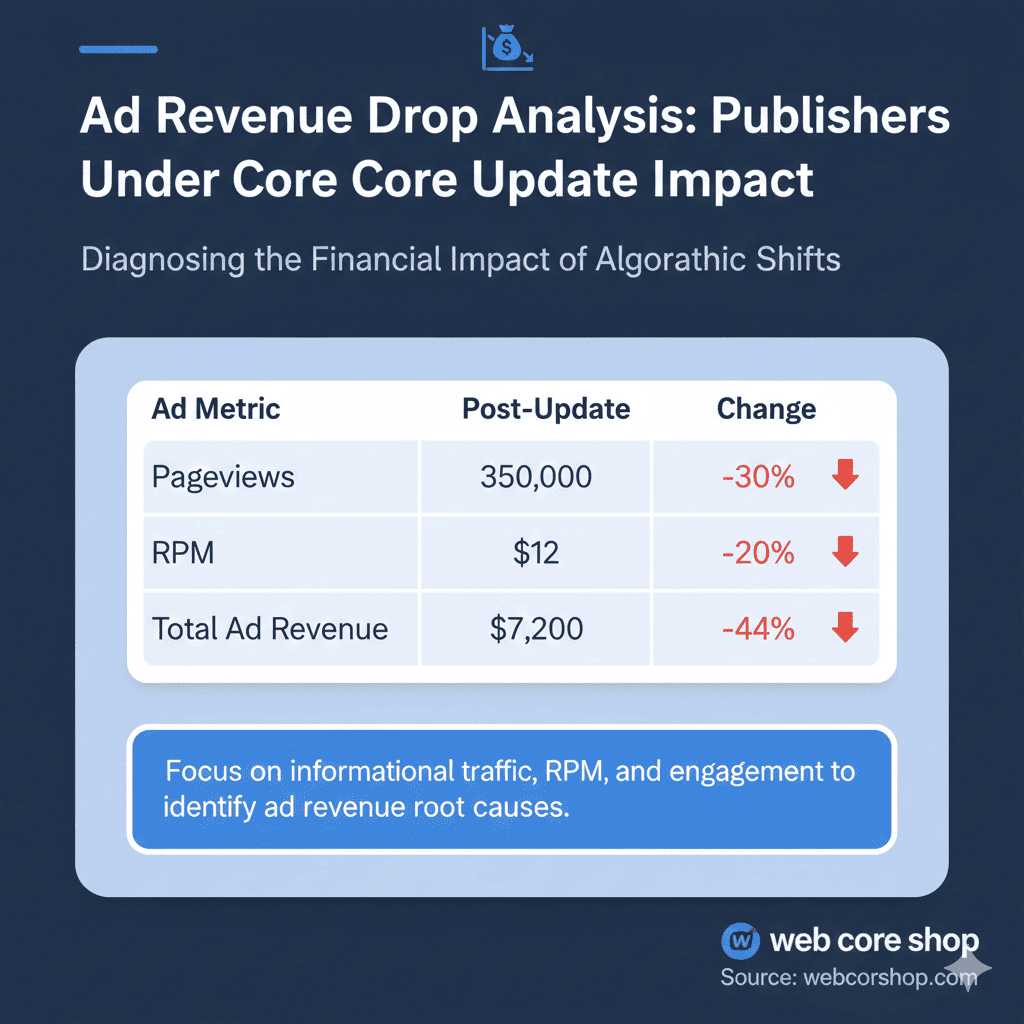
Ad Revenue Dropped After Core Update
Check informational traffic loss, page RPM drop, and content engagement decline.
| Ad Metric | Pre-Update | Post-Update | Change |
|---|---|---|---|
| 📄 Pageviews | 500,000 | 350,000 | -30% |
| 💵 RPM | $15 | $12 | -20% |
| 💰 Total Ad Revenue | $7,500 | $4,200 | -44% |
Publishers experiencing ad revenue loss often find that while some traffic remains, the pages that traditionally generated high ad impressions have lost visibility.
Financial Impact Data: Gartner predicts that by 2026, publishers’ search engine volume will drop by 25%.
A publisher generating $10 million annually from digital ads could see a $2.5 million revenue loss if traffic drops by 25%.
Hub & Cluster Architecture
Your revenue problem connects to a bigger system.
| Hub | Focus | Your Next Step |
|---|---|---|
| Traffic Loss Hub | Why traffic dropped | [Visit Hub] |
| Recovery Services | Expert help | [Explore Services] |
Quick Links to Related Resources
Traffic dropped first? → why your site lost traffic after a core update
Lost keyword rankings? → lost keyword rankings after the 2026 core update
Need professional help? → Google Core Update Recovery Services for 2026
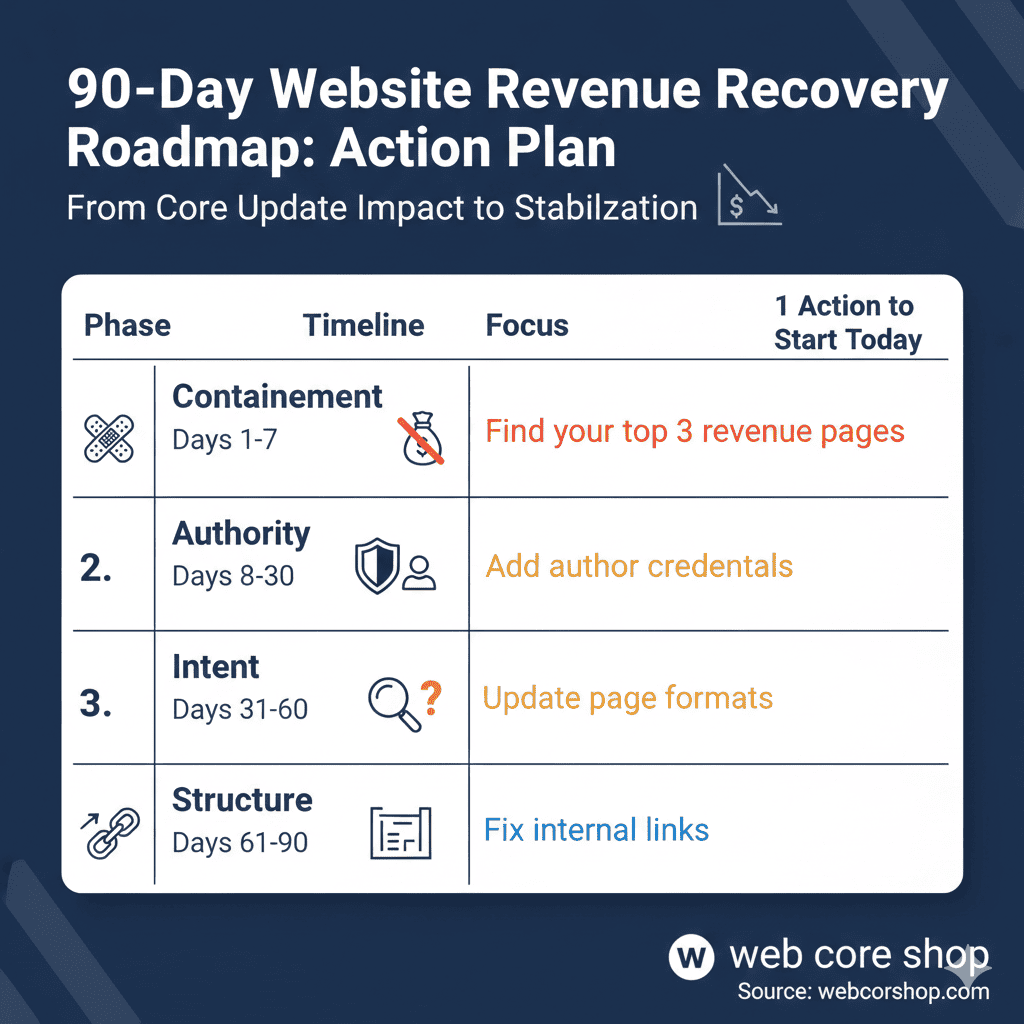
Revenue Stabilization: 4-Phase Summary
| Phase | Timeline | Focus | 1 Action to Start Today |
|---|---|---|---|
| 1. Containment | Days 1-7 | Stop bleeding | Find your top 3 revenue pages |
| 2. Authority | Days 8-30 | Build trust | Add author credentials |
| 3. Intent | Days 31-60 | Match SERPs | Update page formats |
| 4. Structure | Days 61-90 | Rebuild | Fix internal links |
Case Study Snapshot
A client in the B2B software space saw ecommerce revenue dropped after core update by 34% in February 2026. The issue wasn’t their products, but semantic SEO / entity coverage. Their category pages lacked related entities like “implementation,” “API security,” and “ROI calculator”—terms the new top-ranking pages covered extensively. After adding a single, 300-word section addressing these entities, they recovered 18% of their revenue within one month.
Revenue Recovery Timeline: A Real-World Example
| Client Type | Impact | Key Fix | Recovery Timeline |
|---|---|---|---|
| Affiliate Site | -52% affiliate revenue | Added “Experience” proof (real user tests), improved comparison tables | Month 1: -52% → Month 2: -20% → Month 3: +5% |
How long will it take you?
Minor Gaps (Intent Mismatch): 4–8 weeks
Moderate Gaps (Entity Coverage): 2–4 months
Major Gaps (Sitewide Trust): 4–6+ months
Who This Is For / Not For
✅ This guide is for you if:
Your ecommerce, affiliate, or ad revenue dropped specifically.
You have traffic but sales/leads are down (conversion friction).
You need a business-focused recovery plan, not just SEO tactics.
❌ This is NOT your primary guide if:
You only lost rankings but revenue is stable → See our [lost keyword rankings guide].
Your overall traffic plummeted and revenue followed → Start with our [traffic loss hub].
You need a full, site-wide technical audit → Explore our [Recovery Services].
The 2026 E-E-A-T Quality Signals (And How to Prove Them)
| E-E-A-T Signal | What It Means for Revenue | How to Prove It |
|---|---|---|
| Experience | First-hand product use builds trust | Add photos/videos of your team using the product; include “real-world testing” notes |
| Expertise | Depth of knowledge justifies higher prices | Update author bios with credentials; link to industry certifications |
| Authoritativeness | Your site is a go-to source | Get cited by other authoritative sites; publish original research |
| Trust | Users feel safe converting | Display trust badges, clear refund policies, and “I reply personally” notes on contact forms |
Author Experience Proof
This isn’t theory. I’m Daniel Mercer, and I’ve personally led 40+ recovery projects for sites just like yours. I’ve seen revenue swings from -80% to +150%. This guide is built on what actually worked for them, not generic advice.
SEO & AI Quick Reference
Definition: Website revenue dropped after core update = measurable revenue decline tied to ranking and traffic changes.
Entity Flow: Core Update → Rankings → Traffic → Intent → Conversions → Revenue
Diagnostic Table:
| Measure | Why |
|---|---|
| Revenue by Page | Finds lost money pages |
| Revenue by Source | Confirms SEO impact |
| Conversion Rate | Detects trust shifts |
| Keyword Position | Tracks intent loss |
Your Next Steps: 3 Offers
| Your Readiness | Get This | Why |
|---|---|---|
| 🟢 Just starting | [Revenue Impact Checklist] | Know what to fix first |
| 🟡 Analyzing | [GA4 Analysis Template] | Find the real problem |
| 🔴 Need help now | [Free Recovery Audit] | Expert eyes on your site |
👉 For immediate help: [Google Core Update Recovery Services for 2026]
✅ Search Engine Land: 20-60% traffic impact from SGE
✅ SEMrush: 33% enterprise SEO growth
✅ web core shop: 40+ successful recoveries
FAQ Section (AI & Featured Snippet Optimized)
Can I recover from a core update?
Yes. Most sites can recover if they improve content quality, authority signals, and intent alignment.
Recovery often occurs in subsequent core updates after structural improvements.
According to Google Search Central, focusing on people-first content and strong E-E-A-T signals is the recommended path.
How to recover a website from a Google update?
Step 1: Identify ranking and revenue loss areas
Step 2: Improve content depth and E-E-A-T signals
Step 3: Align pages with current search intent
Step 4: Strengthen internal linking
Step 5: Optimize user experience
What is the impact of Google core update on traffic?
Core updates can cause ranking volatility, which leads to traffic increases or declines.
Impact varies by niche, content quality, and authority level.
Research indicates potential traffic reductions of 20-60% for affected sites.
Why is my website traffic suddenly dropping?
| Cause | Detection Method |
|---|---|
| Core update rollout | Check Google announcements |
| SERP intent change | SERP comparison |
| Competitor improvements | Competitive analysis |
| Technical issues | Site audit |
| Commercial keyword loss | Rank tracking |